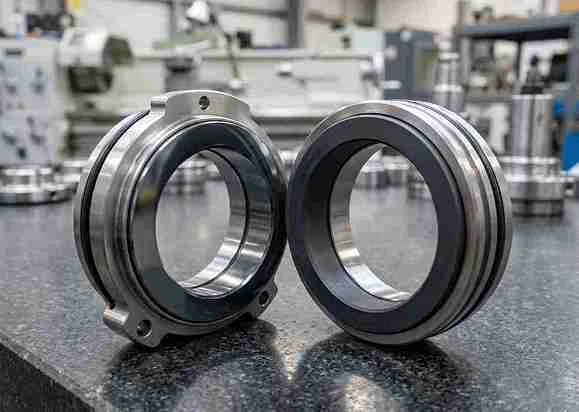

Resin-Impregnated Carbon Seals for Rotating Equipment
CARBOLVE supplies finished carbon graphite seal faces, rings and custom sealing components in resin-impregnated material directions reviewed for the application. Final material and geometry depend on the sealed medium, pressure, temperature, shaft speed, counterface and required surface finish.
- Resin-impregnated carbon graphite material review
- Mechanical seal faces, seal rings and custom geometries
- Drawing and physical-sample evaluation
- OEM, replacement and custom manufacturing support
What Is a Resin-Impregnated Carbon Seal?
A resin-impregnated carbon seal is a carbon graphite sealing component made from a base material whose connected pore structure has been filled with a compatible resin. The impregnation can reduce material permeability and modify mechanical, chemical and temperature behavior. Actual performance remains dependent on the base carbon grade, resin system, operating conditions and complete seal design.
The carbon graphite component may operate as a mechanical seal face, seal ring or another drawing-based sealing part. It is normally one component within a larger sealing system rather than a complete mechanical seal assembly.
Mechanical Seal Faces
Flat or profiled carbon graphite faces manufactured to drawing and surface requirements.
Carbon Seal Rings
Annular sealing components produced according to the required material, dimensions and functional geometry.
Custom Seal Components
Non-standard rings, faces and other carbon graphite sealing geometries produced from drawings or physical samples.
OEM and Replacement Projects
Components evaluated for new designs, existing equipment, obsolete replacements and repeat-order requirements.
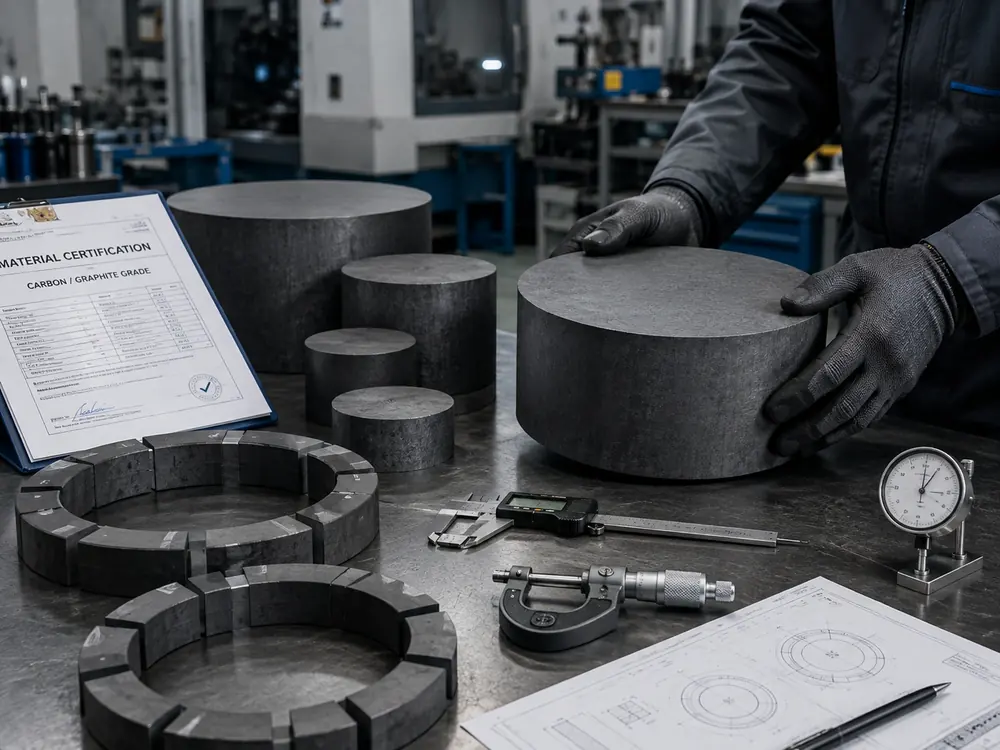

Define the Seal by Material, Function and Geometry
Identification parameters for a resin-impregnated carbon seal
| Specification Area | What Must Be Defined | Why It Matters |
|---|---|---|
| Component function | Mechanical seal face, seal ring or custom sealing component | Determines the working surfaces, loading and geometry |
| Carbon material | Base carbon grade and approved resin impregnation | Controls material behavior and application limits |
| Main dimensions | Outside diameter, inside diameter, thickness and functional face width | Establishes fit and sealing geometry |
| Working surfaces | Flat or profiled face, counterface and required surface finish | Influences the sealing interface and mating relationship |
| Process medium | Liquid or gas, composition and concentration | Determines resin and carbon compatibility |
| Operating conditions | Normal and maximum temperature, pressure and shaft speed | Defines the material and design boundary |
| Counterface | Material, condition and surface requirements | Material pairing affects friction, wear and heat |
| Project source | Drawing, OEM reference, new sample or worn sample | Determines how completely the original specification can be reconstructed |
A black carbon ring cannot be identified reliably by appearance or dimensions alone. Material documentation, equipment information and operating conditions are needed when the existing grade is unknown.
Why Material Name Alone Is Not Enough

The Resin System May Not Suit the Medium
“Resin-impregnated carbon” describes a material direction, not universal chemical compatibility. The exact grade must be reviewed against the sealed liquid or gas, its concentration and the operating temperature.
A Dimensionally Correct Ring Can Still Be the Wrong Material
Matching the outside diameter, inside diameter and thickness does not confirm permeability, strength, wear behavior or temperature capability. CARBOLVE reviews the existing material information together with the application conditions.
A Worn Sample May Not Preserve the Original Surface
A used seal can show general geometry and mounting features, but wear may change the original thickness, working-face condition, surface finish or sealing-band geometry. A drawing, equipment model and operating data help complete the replacement specification.
Replacing the Carbon Component May Not Correct a System Problem
Leakage or rapid wear may also involve the counterface, secondary seals, springs, alignment, shaft condition, vibration, lubrication or installation. The carbon component should be evaluated as part of the complete sealing system.
What Resin Impregnation Changes

Potential Engineering Advantages
- ● Reduced permeability through the carbon graphite body
- ● Modified mechanical strength and structural behavior
- ● Material options for selected liquid and gas sealing applications
- ● Retention of application-relevant carbon graphite sliding characteristics
- ● Finished components that can be machined to project-specific geometry
Important Selection Boundaries
- ● Resin chemistry must be compatible with the sealed medium.
- ● Temperature capability is grade-specific, not universal.
- ● Pressure and speed must be assessed with the complete seal design.
- ● Low-viscosity fluids, thermal cycling and marginal lubrication can require additional review.
- ● Resin-impregnated carbon is not automatically the preferred choice for every high-temperature, high-pressure or abrasive application.
- ● Food, pharmaceutical or potable-water suitability must never be assumed without exact grade documentation and applicable approval.
Resin-Impregnated Carbon Compared with Other Seal Material Directions
| Material Direction | General Selection Purpose | Main Questions Before Selection |
|---|---|---|
| Resin-impregnated carbon graphite | Reduce permeability and modify mechanical or chemical behavior for compatible service conditions | Which resin grade, medium, temperature, pressure, speed and counterface? |
| Metal-impregnated carbon graphite | Modify strength, heat transfer, permeability or tribological behavior for selected demanding conditions | Which metal system, medium, temperature, pressure and application restrictions? |
| Other carbon graphite grades | Address application-specific sliding, thermal or chemical requirements | Which verified grade and what operating atmosphere or lubrication regime? |
| Hard mating-face materials | Provide the opposing working surface in selected mechanical seal pairs | Which hard face, fluid, solids level, heat load and seal design? |
These directions are not direct substitutes. The decision must consider the complete face pair or sealing arrangement. A resin-impregnated carbon component may operate against a harder counterface, but the mating material must be selected as part of the seal system.
Where Resin-Impregnated Carbon Seals May Be Considered
| Equipment Direction | Possible Carbon Component | Application Conditions to Review |
|---|---|---|
| Industrial pumps | Mechanical seal face or carbon seal ring | Process fluid, pressure, temperature, speed, solids, counterface and lubrication |
| Compressors | Seal ring, face or application-specific carbon component | Gas type, pressure, shaft speed, temperature and sealing arrangement |
| Mixers and agitators | Mechanical seal face or custom ring | Medium, shaft movement, pressure, speed, installation and face loading |
| Turbines | Ring or custom carbon sealing component | Gas or steam conditions, temperature, speed, clearance and geometry |
| Rotary joints | Carbon graphite sealing face or ring | Transferred medium, temperature, pressure, rotation and mating surface |
| Other rotating systems | Drawing-based carbon sealing component | Seal function, operating conditions, material documentation and complete geometry |


From Drawing or Sample to a Finished Carbon Seal Component


Drawing-Based Manufacturing
Production can be evaluated from a complete engineering drawing that defines the material, dimensions, working surfaces and non-standard geometry.
Physical-Sample Evaluation
A new or worn sample can support product identification, but it may not reveal the original material grade, impregnation, tolerance or surface condition.
Application-Based Material Review
The material direction is reviewed against the sealed medium, pressure, temperature, shaft speed, counterface and required surface finish.
Custom Component Geometry
CARBOLVE supports flat or profiled seal faces, rings and non-standard carbon sealing geometries according to the approved drawing or sample.
Inspection and Packing
Manufacturing control can include incoming material review, in-process checks, surface inspection, final verification, product identification and protective packing.
Connecting the material review with the component drawing helps reduce ambiguity between the requested grade, finished geometry and operating application.
Resin-Impregnated Carbon Seal Selection Guide
What are the advantages of resin-impregnated carbon seals?
Resin impregnation can reduce permeability through the carbon graphite body and modify its mechanical and chemical behavior. This can make a compatible grade useful for selected sealing applications where fluid or gas must not pass through the material structure.
The result is still grade-specific. Impregnation does not guarantee unlimited pressure, dry-running capability, chemical resistance, wear life or temperature performance. These limits must be confirmed for the base carbon, resin system and complete sealing arrangement.
What are the primary applications for resin-impregnated carbon seals?
Possible applications include mechanical seal faces and carbon seal rings in pumps, compressors, mixers, turbines, rotary joints and other rotating systems. The component may be rotary or stationary depending on the seal design.
Application category alone does not select the grade. The buyer must also evaluate the medium, temperature, pressure, speed, counterface, lubrication condition, geometry and required surface finish.
How does a resin-impregnated carbon seal compare with a standard mechanical seal?
They are not equivalent product categories. A resin-impregnated carbon seal face or ring is a material-specific component. A complete mechanical seal is an assembly that may include rotary and stationary faces, secondary seals, springs, metal retainers, sleeves and other hardware.
CARBOLVE’s verified scope on this page is the finished carbon graphite component. Complete mechanical seal assembly supply should only be stated for a separately verified project.
Are resin-impregnated carbon seals the best choice for high-temperature environments?
Not automatically. The words “resin-impregnated” do not provide a universal temperature limit. Selection depends on the exact resin grade, exposure time, process medium, pressure, speed, thermal cycling, lubrication and counterface.
For conditions beyond the verified resin-grade limit, another carbon or impregnated material direction may need to be considered. The decision should be based on documented material data and the complete application, not a generic “best for high temperature” claim.
How should buyers evaluate a custom resin-impregnated carbon seal manufacturer?
- Can the supplier distinguish the base carbon grade from the impregnation?
- Does the quotation identify the exact component rather than only a common size?
- Can production be reviewed from a drawing, physical sample or equipment reference?
- Are the medium, temperature, pressure, speed and counterface included in material review?
- Are working surfaces, dimensions and inspection requirements clearly defined?
- Does the supplier explain whether it provides the carbon component or the complete seal assembly?
- Can the finished products be identified and protectively packed?
These checks are more useful than unsupported rankings, “heavy-duty” labels or generic durability claims.
Focused Carbon and Graphite Manufacturing
CARBOLVE manufactures industrial carbon and graphite components for OEM manufacturers, distributors and equipment maintenance companies. Production is evaluated from drawings, physical samples, equipment models, dimensions, material requirements and operating conditions.

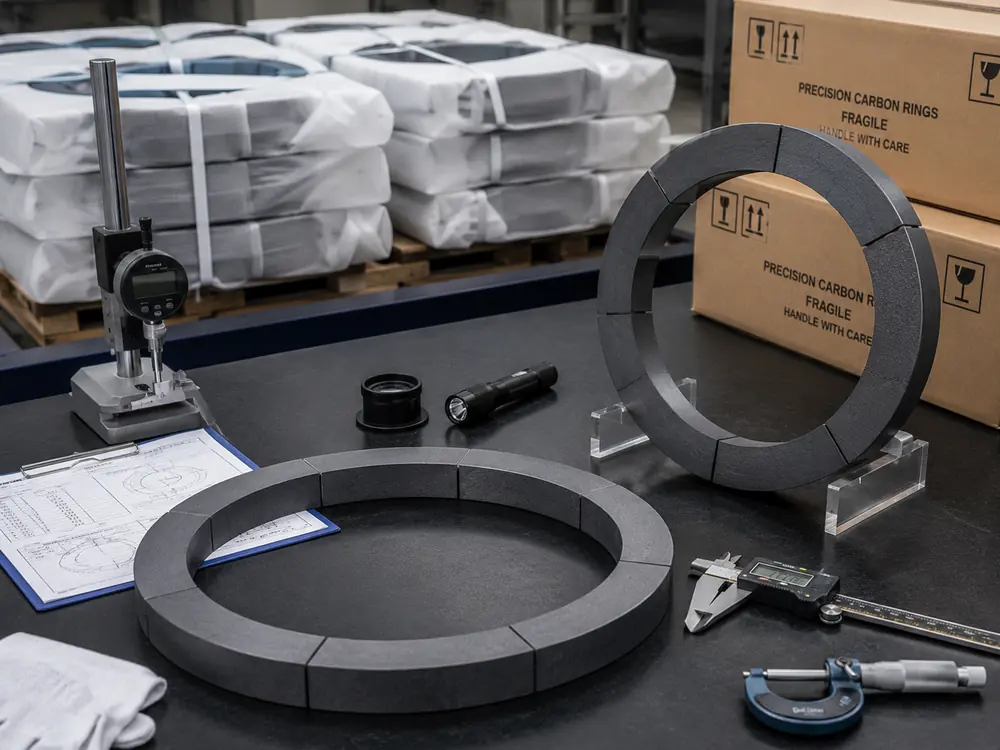
Precision Machining
Grinding, drilling, slotting, surface finishing and drawing-based custom geometries.
Inspection Control
Incoming material review, in-process checks, surface inspection and final verification.
Export Support
Technical communication, protective packing and international B2B documentation.
Project Flow
Related Carbon Seal Products and Project Paths
Request a Resin-Impregnated Carbon Seal Evaluation
Send the available drawing or sample reference, component type, dimensions, existing material grade, sealed medium, normal and maximum temperature, pressure, shaft speed, counterface, surface requirement, quantity and destination country. CARBOLVE will use the available information to discuss material direction, manufacturing feasibility and quotation details.