Custom Carbon Brushes Manufacturer
CARBOLVE evaluates and manufactures custom carbon brushes based on your verified drawings, physical samples, dimensional sketches, or existing motor and generator data. We review material grades, dimensions, contact faces, shunts, terminals, and multi-section constructions to establish a controlled specification for prototype, OEM, obsolete replacement, and repeat production projects.
Send your brush drawing, physical sample, dimensions, machine model, existing material grade, operating conditions, and required quantity for technical review.


What Are Custom Carbon Brushes?
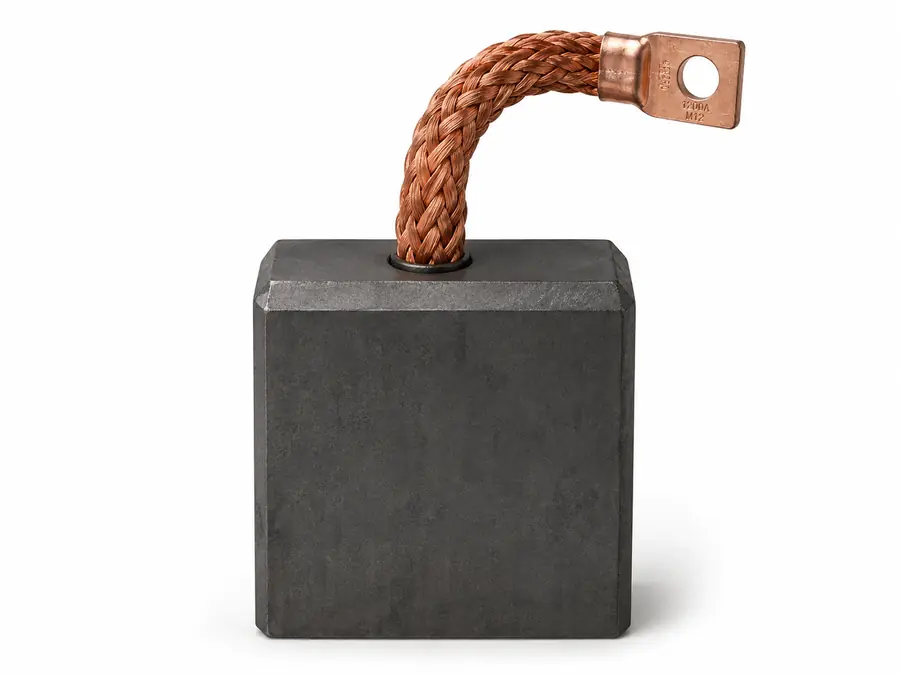
A custom carbon brush is an electrical sliding contact manufactured to an application-specific specification rather than selected only by a standard stock size or part number. Depending on the project, the material, dimensions, contact face, shunts, terminals, springs, brush sections, marking, or packaging can be customized.
Correct customization requires understanding the motor or generator, commutator or slip ring surface, current load, operating speed, brush holder dimensions, spring pressure, and the surrounding environment. Final customization scope depends on CARBOLVE’s verified manufacturing capability and the technical requirements of the application.
What Can Be Customized on a Carbon Brush?
Customization options depend on material, brush size, electrical requirements, manufacturing feasibility, and the approved product specification.
Material Grade
When operating conditions change or existing brushes wear rapidly, standard grades may underperform. We select from verified available grades including electrographite, graphite, copper graphite, and silver graphite based on your current density and speed data to establish stable contact.
Brush Dimensions
Holder clearances dictate physical fit. Incorrect sizing causes sticking or excessive vibration. We machine thickness, width, length, stepped profiles, and special body shapes according to your drawings or holder measurements to ensure correct mechanical operation.
Contact Face Geometry
A flat brush takes time to seat on a curved commutator, risking early electrical damage. We customize flat, radiused, beveled, angled, or grooved contact faces based on your commutator or slip-ring diameter to accelerate proper seating.
Shunts & Leads
High currents or vibrating environments stress conductor paths. We customize shunt quantity, position, length, cross-section, and insulation according to your mechanical constraints to prevent conductor fatigue and overheating.
Terminals
Machine connections vary widely, and forcing a standard terminal risks loose connections. We provide verified terminal forms including ring, eyelet, flag, fork, and spade based on your mounting method and hardware specifications.
Brush Sections
Difficult commutation in large DC motors requires optimized contact dynamics. We manufacture single-section, multi-section, split, and paired brushes according to approved existing OEM designs to support current distribution.
Custom Carbon Brushes by Project Requirement

Drawing-Based Production
For buyers with a complete drawing, material specification, and construction details.
Sample-Based Production
For projects starting from an existing worn sample, unknown part number, or incomplete drawing.

OEM Product Development
Specification development for new motors, generators, equipment, and spare-parts programs.

Obsolete Brush Replacement
For equipment where OEM supply has stopped, drawings are unavailable, and only samples remain.
Standard vs Custom Carbon Brushes
Custom does not automatically mean better. A standard brush is appropriate when an approved specification already satisfies the application. Customization defines a new specification.
| Factor | Standard Brush | Custom Brush |
|---|---|---|
| Definition | Existing catalog spec | Application-specific approved spec |
| Dimensions | Predefined | Customized where feasible |
| Material | Existing grade | Selected from verified grades |
| Contact Face | Existing geometry | Application-specific geometry |
Carbon Brush Drawing vs Physical Sample
The best custom-development input is usually a combination of drawing, physical sample, machine information, and operating data.
| Information | From Drawing | From Physical Sample |
|---|---|---|
| Original Dimensions | Usually available | Worn dimensions may differ |
| Material Grade | May be specified | May be unknown |
| Original Length | Defined | May not be recoverable |
| Tolerance | May be specified | Cannot always be inferred |
What a Worn Carbon Brush May Not Tell Us
A worn carbon brush is valuable for replacement identification, but it is not always a complete engineering specification. A severely worn sample may not reliably reveal:
- Original brush length & contact-face radius
- Exact original material grade or properties
- Original dimensional tolerances
- Original electrical load or OEM testing criteria
Therefore, request additional information such as machine model, brush holder, and operating data.
Why Dimensions Alone Are Not Enough
Two carbon brushes with identical external dimensions may require completely different materials or constructions because their operating environments differ.
A dimensions-only approach matches physical size but may ignore critical factors like current density, peripheral speed, commutator vs. slip ring surface, holder pressure, and ambient temperature.
Custom Brush Development Workflows
Drawing-to-Production
- 1. Receive and evaluate drawing.
- 2. Review material, dimensions, and contact face.
- 3. Review shunts, terminals, and holder requirements.
- 4. Clarify incomplete specifications and feasibility.
- 5. Produce sample if required and inspect.
- 6. Proceed with batch production to approved spec.
Sample-to-Production
- 1. Receive physical sample and photographs.
- 2. Record markings and measure remaining dimensions.
- 3. Inspect contact face, shunts, and terminals.
- 4. Identify missing original dimensions and review material.
- 5. Create controlled specification and produce sample.
- 6. Customer validation followed by batch production.
Note: Physical reproduction is not the same as confirmed material equivalence.
Custom Carbon Brush Manufacturing & Quality Control
CARBOLVE manufactures finished custom brushes according to verified procedures. We do not claim proprietary raw-powder formulation unless explicitly verified for the project.
Precision Machining
We machine thickness, width, length, radiuses, bevels, grooves, and special profiles from verified carbon/graphite blanks according to the approved drawing.
Assembly
Shunt installation, terminal assembly, and multi-section construction are performed using verified methods to ensure mechanical integrity under electrical load.
Dimensional & Surface Inspection
Quality control checks dimensions (T/W/L), contact face geometry, shunt position, terminal orientation, and inspects for chips, cracks, or contamination before packaging.


Frequently Asked Questions
Can CARBOLVE manufacture a carbon brush from a physical sample?
Can CARBOLVE manufacture a brush from dimensions only?
Can two carbon brushes with the same dimensions use different materials?
Can CARBOLVE cross-reference another manufacturer's brush grade?
Does every custom project require a prototype?
Need a Custom Carbon Brush for a New or Existing Application?
The more complete the dimensional, material, machine, electrical, mechanical, and environmental information, the more accurately CARBOLVE can evaluate manufacturing feasibility and prepare a controlled product specification.
What Information Is Needed for a Quote?
- Drawing or Sample
- Dimensions (T × W × L)
- Machine Model & Data
- Voltage & Current
- Existing Part Number
- Required Quantity
Direct Contact:
Email: sales@carbolve.com
Phone: +86(513)-81100106
Address: No.1,Taoyuan Road, Nantong City, Jiangsu Province, China