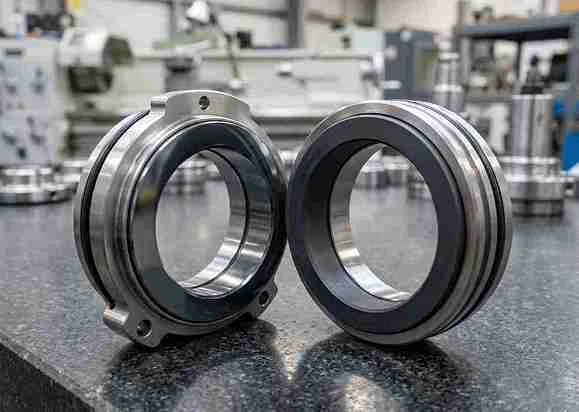

Mixer Mechanical Seal Faces
CARBOLVE manufactures carbon graphite seal faces and profiled rings for mixer and agitator sealing applications. Drawing-based production brings component geometry, material selection and mating-face requirements into the same technical review.
For new equipment and replacement parts, the focus is the carbon component and its fit within the existing seal design.
Choose the Carbon Component Geometry
Start with the component drawing. A sealing face and the ring body serve different purposes: the face forms the sealing interface, while the body locates and supports the component within the assembly.
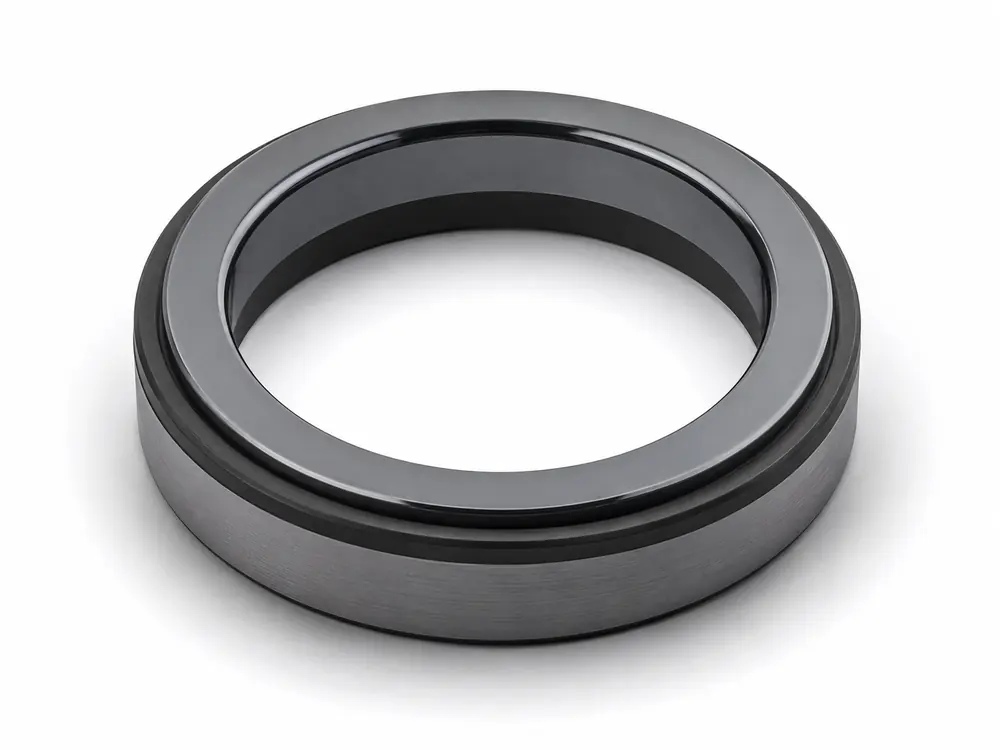
Flat Carbon Graphite Seal Faces
Carbon graphite components with a flat sealing face, manufactured to agreed drawing and surface requirements.
Selection starts with the inside and outside diameters, axial thickness, sealing band and mating surface. The component's rotating or stationary role is determined by the seal assembly, not by its appearance alone.

Profiled Carbon Graphite Seal Rings
Drawing-based carbon graphite rings with steps, grooves or other specified body features for installation and location within a mixer seal.
Profiled describes the component geometry; it does not automatically mean a curved sealing surface. Review mounting features, section thickness and the working face together.
A Matching Diameter Is Only the Starting Point
Two rings can share the same outside diameter and still differ in sealing contact, mounting fit or material suitability. For a replacement, copying the worn part alone can also carry existing wear into the new specification.
CARBOLVE evaluates drawings, samples and operating information together to define the carbon component before production.
Evaluate the Conditions at the Seal Faces
The liquid inside a vessel does not necessarily lubricate a top-entry mixer seal. Establish whether the faces operate with liquid lubrication, intentional dry contact or another engineered arrangement.
Mixer shaft movement also matters. Runout, axial movement and deflection must remain within the seal assembly's limits; a different carbon grade is not a substitute for correcting an installation or mechanical problem.

Illustrative geometry. Production follows the approved component drawing.
| Selection issue | Why it matters | Practical response |
|---|---|---|
| A replacement looks similar but does not fit correctly | Steps, grooves, thickness and locating features can differ even when the main diameters match. | Compare the full component geometry and mating assembly, using a drawing where available. |
| The old face has uneven wear or damaged edges | A used sample may no longer represent the original dimensions or surface condition. | Separate wear from intended geometry before agreeing the replacement dimensions. |
| The same carbon grade is requested for a changed process | A new medium, cleaning cycle or lubrication condition can change material suitability. | Review the base carbon and impregnant against the actual service conditions. |
| Leakage returns after a face change | Shaft movement, the mating face, secondary seals or the support system may remain part of the problem. | Check the complete sealing arrangement; changing the carbon component alone may not resolve the cause. |
Carbon Material Selection for Mixer Seal Faces
Material selection involves both the carbon structure and its impregnation or treatment. The references below provide starting points for technical discussion, rather than an automatic grade recommendation for every mixer.
| Material direction | CARBOLVE grade references | Starting point for review | Selection boundary |
|---|---|---|---|
| Resin-impregnated carbon graphite | CVM-CG-R20, CVM-CG-R30 | General mechanical sealing and applications where a resin-impregnated carbon is specified. | Check compatibility with the process liquid, cleaning agents and face temperature. |
| High-temperature resin carbon | CVM-CG-HR40 | Projects requiring review of an elevated-temperature resin system. | Confirm the resin system and actual operating environment; the grade name is not a seal temperature rating. |
| Antimony-impregnated carbon graphite | CVM-CG-A20, CVM-CG-A30, CVM-CG-A40 | Metal-impregnated material review for demanding mechanical seal duties. | Evaluate chemical compatibility, contact restrictions and the complete face arrangement. |
| Copper-impregnated carbon graphite | CVM-CG-C30, CVM-CG-C40 | Projects specifying copper impregnation or requiring consideration of heat transfer. | Review the medium and component design; copper impregnation does not establish a universal pressure limit. |
Fine-Grain References Within the Material Selection
CVM-FG-R30 and CVM-FG-A40 provide fine-grain resin and antimony carbon references for seal-face review. They are material directions within the selection process, not additional component geometries.
For chemical mixers, include the process composition, concentration, temperature and cleaning exposure. Compatibility must consider the impregnant as well as the carbon.
Grade references support preliminary selection. Material development targets are not guaranteed component specifications. Final material, acceptance criteria and application suitability must be agreed for the project.
Carbon Component Manufacturing Around Your Seal Design
1 Geometry and Material Reviewed Together
Component dimensions, body features and material requirements are considered as one specification, helping keep the manufacturing discussion aligned with the intended sealing arrangement.
2 Support for New and Replacement Components
Drawings, physical samples and equipment information can support evaluation for new designs, maintenance parts and obsolete replacements. Replacement suitability is reviewed against the required component and assembly details.
3 Machining to Defined Requirements
Grinding, drilling, slotting and surface finishing support drawing-based carbon component production. Critical dimensions and surface requirements are established for the individual part.

Manufacturing and Inspection
CARBOLVE's component workflow includes incoming material review, in-process checks, surface inspection and final verification.
Before dispatch, agreed dimensions, appearance and packing requirements are checked. Protective packing and technical communication support international purchasing and delivery coordination.
Acceptance should follow the agreed component specification. Where additional testing or documentation is required, define its scope before ordering.
Mixer Seal Face Selection and Replacement Guide
1. How do carbon and ceramic seal faces compare?
Carbon and ceramic are often partners in a sealing pair, not interchangeable choices for the same component. "Ceramic" also needs clarification: alumina and silicon carbide are different materials.
| Material | Role in the selection discussion |
|---|---|
| Carbon graphite | The carbon-side grade must match the counterface, chemistry and lubrication regime. |
| Alumina ceramic | A hard-face option in certain seal arrangements; confirm the exact grade and intended duty. |
| Silicon carbide | A hard-face option considered for chemical and wear demands; the grade, pairing and lubrication conditions still matter. |
CARBOLVE's offer here covers the carbon component. Identification of a mating material does not mean that the complete face pair or seal assembly is included.
2. Is carbon the best choice for abrasive mixing media?
Not automatically. Hard particles reaching the sealing interface can accelerate wear of a carbon face. Particle hardness, size, concentration and access to the faces all influence the decision.
A hard-face pairing or a suitable flush or barrier arrangement may be more appropriate for some abrasive duties. These are seal-system decisions. Increasing the carbon grade designation alone is not a reliable solution to solids-related wear.
3. Can a carbon mixer seal face run dry?
Only when the material, counterface and seal arrangement have been selected for that duty. Intentional dry-running seals differ from wet-running seals that accidentally lose lubrication.
For a top-entry mixer, check the environment at the seal rather than assuming that liquid in the tank reaches the faces. A carbon or electrographite grade name alone does not establish continuous dry-running capability.
4. What should be checked when a mixer seal starts leaking?
Leakage is a symptom, not a diagnosis. A qualified technician should consider:
- Face scoring, chipping, cracking or uneven wear.
- The condition and alignment of the mating face.
- Shaft runout, axial movement and bearing condition.
- Secondary seals and component seating.
- Lubrication, flush or barrier conditions where applicable.
- Changes in process chemistry, solids or cleaning cycles.
Replacing the carbon ring may be part of the repair, but it will not necessarily correct a damaged counterface or an assembly-level problem.
5. How should replacement faces be installed?
Follow the equipment and seal manufacturer's procedure. Isolate the drive and process, release stored pressure, and make the equipment safe before work begins.
Protect the faces from contamination and impact. Confirm orientation, locating features and component seating. Do not improvise setting lengths, clearances, spring compression, tightening values or face lubrication.
Installation and recommissioning should be completed by qualified personnel. The supplied carbon ring is a component, not a substitute for the assembly's installation instructions.
6. What affects replacement cost and supplier comparison?
Compare quotations against the same scope: carbon ring only, a complete face pair, or a full seal assembly. These are different purchases.
For a carbon component, cost depends on material direction, geometry, quantity, surface requirements and agreed inspection or documentation. A worn sample with incomplete dimensions may also require further technical clarification before production can be defined.
CARBOLVE evaluates drawing- and sample-based carbon components for international customers. Confirm the agreed specification, delivery destination and commercial terms in the quotation; do not assume local stock or universal equipment compatibility.
Related Carbon Sealing Resources
Discuss Your Mixer Seal Face Requirement
Send the component drawing or available dimensions, existing material reference and operating conditions. For a replacement, include the mixer or seal identification and photographs of the removed part.
We will review the carbon component scope, geometry and material direction before preparing the quotation.