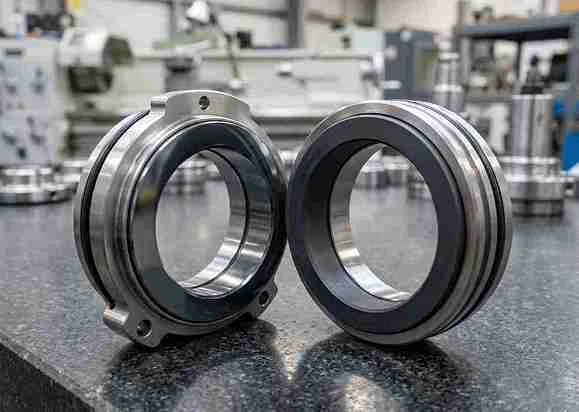
Compressor Vanes for Dry Rotary Vane Compressors
CARBOLVE manufactures custom and replacement carbon and graphite compressor vanes for applicable dry-running and oil-free rotary vane compressors. We support drawing-based and sample-based production with precision-machined edge geometry and verified dimensional inspection for OEM, replacement, and obsolete vane projects.
Not all rotary vane compressors use carbon or graphite vanes. Material compatibility must be confirmed according to the compressor design and original specification.
- Carbon & Graphite Compressor Vanes
- Dry-Running Compressor Applications
- Drawing & Sample-Based Production
- Precision-Machined Geometry
Send the compressor manufacturer/model, existing material, vane dimensions, quantity per set, operating pressure, RPM, photos, and required quantity.

Which Compressor Vanes Does CARBOLVE Manufacture?
This page focuses on sliding compressor vanes used in applicable rotary vane compressors, particularly carbon and graphite vane components for suitable dry-running or oil-free compressor designs.
CARBOLVE Product Focus
- • Carbon compressor vanes
- • Graphite compressor vanes
- • Carbon graphite compressor vanes
- • Verified specialized carbon materials
- • Dry-running / oil-free compressor applications
- • Custom and replacement projects
Different Technologies (Requires Verification)
- • Metal vanes & Steel vanes
- • Fiber composite vanes
- • Oil-lubricated compressor blades
- • Automotive AC compressor vanes
- • Centrifugal compressor guide vanes
- • Axial compressor vanes
If your existing compressor vane is metal, fiber composite, or another non-carbon material, do not substitute a carbon or graphite vane without engineering verification.
Compressor Vanes by Project and Application

Dry Rotary Vane Compressor Vanes
For applicable dry-running compressors using carbon/graphite vanes.

Oil-Free Compressor Vanes
Only where the compressor specifies a suitable carbon/graphite material.

Graphite Compressor Vanes
Material-specific graphite products for suitable applications.

Carbon Graphite Compressor Vanes
For verified carbon-graphite compressor applications.

Replacement Compressor Vanes
For existing part numbers, models, drawings, or physical samples.

Custom Compressor Vanes
For custom dimensions, edge geometry, obsolete applications.

OEM Compressor Vanes
For new rotary vane compressor development and production.

Compressor Vane Sets
For machines requiring multiple vanes per rotor installation.
What Are Compressor Vanes?
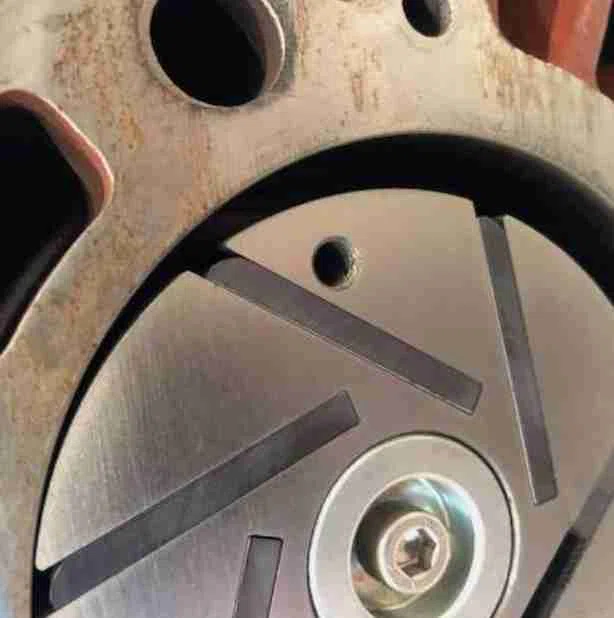
Compressor vanes are sliding components installed in the rotor of a rotary vane compressor. As the eccentric rotor turns, the vanes move radially against the surrounding stator or cylinder surface, creating separate chambers that progressively reduce in volume and compress air or gas.
This page refers to rotary sliding compressor vanes, not centrifugal or axial compressor guide vanes.
Main Vane Features:
- • Vane body
- • Sliding faces
- • Vane tip / contact edge
- • Leading edge
- • Trailing edge
- • Side surfaces
- • Chamfer/radius
- • Rotor slot fit
How Do Rotary Vane Compressor Vanes Work?
The rotor rotates eccentrically inside the stator.
Vanes slide radially in rotor slots.
Vane tips maintain the required relationship with the stator/cylinder surface.
Adjacent vanes create closed chambers.
Chamber volume decreases toward the outlet.
Air or gas is compressed and discharged.
Depending on compressor design, vane contact and sealing behavior may involve dry carbon/graphite sliding, a lubricating oil film, or other material/lubrication systems. Do not describe all rotary vane compressors using one contact mechanism.
Which Rotary Vane Compressors Use Carbon or Graphite Vanes?
| Compressor Type | Carbon / Graphite May Apply? | Important Note |
|---|---|---|
| Dry rotary vane compressor | Common in suitable designs | Verify exact grade |
| Oil-free rotary vane compressor | May apply | Confirm OEM specification |
| Combination vacuum/pressure pump | May apply | Verify both operating modes |
| Oil-lubricated industrial rotary vane | Do not assume | Original vane may be different material |
| Centrifugal / Axial compressor | No sliding rotor vane | Different compressor technology |
| Screw / Reciprocating compressor | No sliding rotor vane | Uses screw rotors or pistons |
The compressor type must be identified before discussing vane material.
Dry-Running vs Oil-Lubricated Rotary Vane Compressors
Dry / Oil-Free Characteristics
- • No lubricating oil film inside the compression chamber.
- • Suitable self-lubricating vane material becomes important.
- • Carbon/graphite vanes may be used in suitable designs.
- • Dust and filtration strongly affect wear.
Oil-Lubricated Characteristics
- • Oil participates in lubrication/sealing/cooling depending on design.
- • Vane material may be metal, composite or another material.
- • Carbon/graphite should not be assumed.
- • Oil condition becomes an additional system factor.
Compressor Vane Material Options
Graphite
For verified compressor applications requiring a suitable graphite vane material.
Carbon Graphite
For grade-specific dry-running compressor applications.
Fiber / Phenolic
A different industry material family. (Not supplied by CARBOLVE unless verified).
Metal / Steel
Used in some compressor designs. Do not substitute carbon without verification.
Key Characteristics of Carbon & Graphite Vanes
Self-Lubricating
Suitable grades provide dry sliding (grade dependent).
Friction
Influences heat, wear, and compressor load.
Mechanical Strength
Important for start/stop, pressure, slot movement.
Thermal Expansion
Relevant to compressor temp and vane-slot fit.
Compressor Vane Material Properties Framework
| Property | Engineering Relevance | CARBOLVE Data |
|---|---|---|
| Material Grade | Exact material identity | [Verified per project] |
| Density (g/cm³) | Material consistency | [Verified per project] |
| Hardness | Wear/machining behavior | [Verified per project] |
| Flexural Strength | Breakage resistance | [Verified per project] |
| Thermal Expansion | Dimensional behavior | [Verified per project] |
| Maximum Temp | Thermal suitability | Application dependent |
Compressor Vane Engineering & Dimensions
Different compressor manufacturers name dimensions differently. Always accompany measurements with a drawing or annotated photo.

Custom Compressor Vane Dimensions
- L = Length
- H or W = Height / Width
- T = Thickness
- Also measure where applicable: Chamfer, Radius, Beveled edge, Groove, Slot, Hole, Step.
Compressor Vane Specifications
| Parameter | Required Information |
|---|---|
| Material | Original or proposed grade |
| L, H/W, T | Drawing/sample |
| Flatness/Parallelism | Approved specification |
| Edge Geometry | Drawing/sample (Chamfer, Radius) |
| Vane Quantity | Compressor model dependent |
Edge Geometry
Influences rotor-slot entry, sliding behavior, and stator contact. Reproduce the verified drawing rather than applying generic edges.

Rotor-Slot Fit
Vanes must move radially. Too tight = sticking/breakage. Too loose = tilting/leakage. Do not publish universal clearances.

Stator Surface
Vane behavior depends on the surface. Check for scoring, grooves, deposits. A new vane cannot compensate for a damaged stator.

How to Identify Replacement Compressor Vanes
What a Worn Vane Can & Cannot Tell Us
A worn compressor vane is useful for identification but should not automatically be treated as the complete original manufacturing specification.
Can Identify:
- • Thickness & Length
- • Basic geometry
- • Wear pattern
- • Visible markings
May Remain Unknown:
- • Original unworn height
- • Exact material grade
- • Original tolerances
- • Maximum pressure/RPM

How CARBOLVE Manufactures Finished Compressor Vanes
Precision machining processes based on verified material specifications.
1. Material & Blank Prep
Confirm approved material, check references, and prepare the carbon/graphite blank.
2. Precision Machining
Control length, height, thickness, flatness, parallelism, and squareness where verified.
3. Edge & Special Features
Machine chamfers, radii, bevels, grooves, or holes according to the drawing.
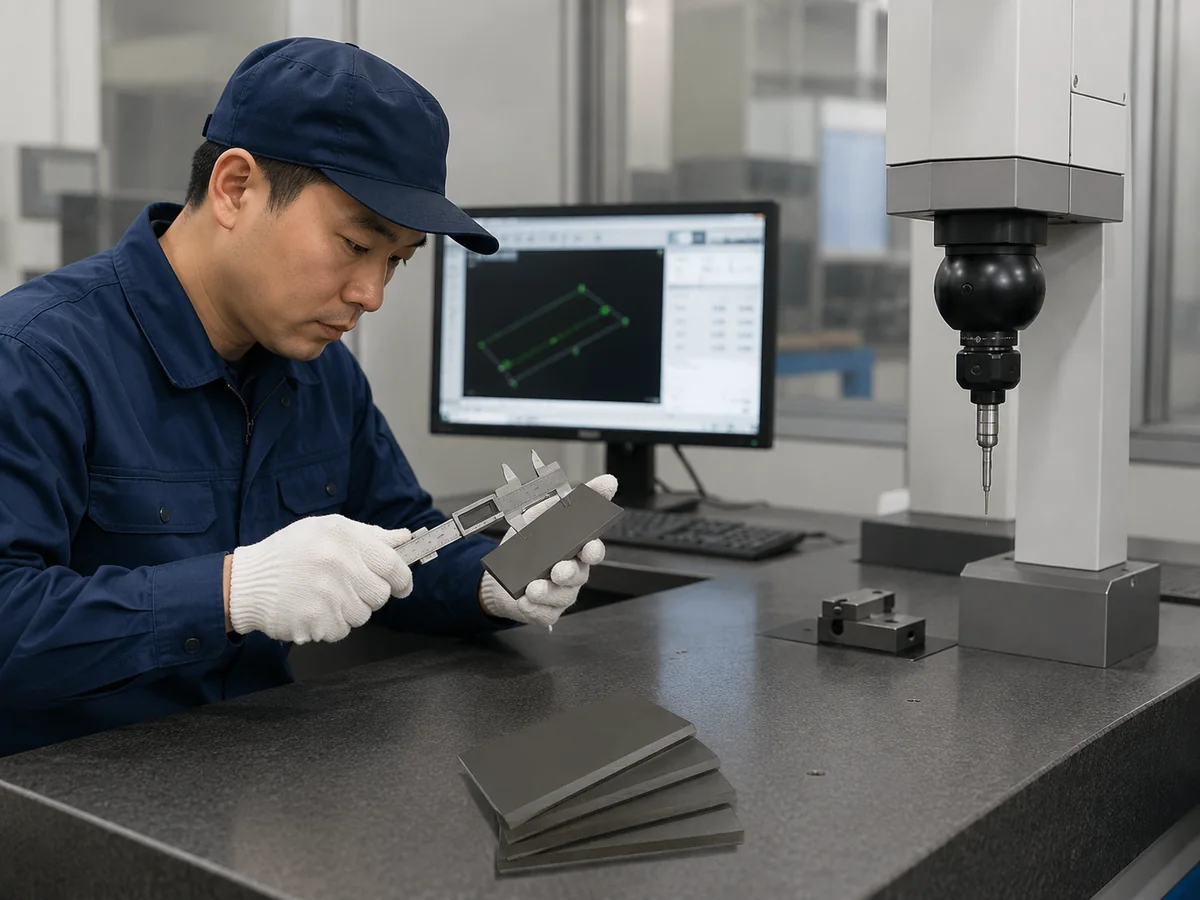
Compressor Vane Quality Control
- Material Verification: Grade and documentation.
- Dimensions: Length, height, thickness, features.
- Geometry: Flatness, parallelism, squareness.
- Surface: Chips, cracks, scratches, contamination.
Rotary Compressor Vanes vs Compressor Guide Vanes
Rotary Vane Compressor Vane
- • Slides inside rotor
- • Creates compression chamber
- • Positive-displacement compressor
- • CARBOLVE page scope (where carbon/graphite applies)
Compressor Guide / Stator Vane
- • Directs airflow
- • Axial/centrifugal turbomachinery
- • Does not perform sliding function
- • Outside this page scope
Frequently Asked Questions
Do all rotary vane compressors use graphite vanes?
Can a carbon vane replace a metal compressor vane?
Can two compressor vanes with the same dimensions use different materials?
Can CARBOLVE reproduce a worn compressor vane?
Does low compressor pressure always mean the vanes are worn?
Need Compressor Vanes for a Dry Rotary Vane Compressor?
Complete compressor, material, dimensional, mechanical, pressure and environmental information helps CARBOLVE determine whether a carbon or graphite vane is appropriate before preparing the product specification and quotation.
Direct Contact
Email: sales@carbolve.com
Phone: +86(513)-81100106
Address: No.1,Taoyuan Road, Nantong City, Jiangsu Province, China