
Carbolve Logo

Carbon Seal Manufacturer 

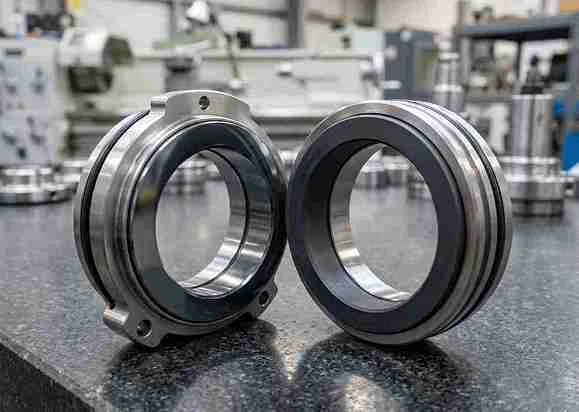
CARBOLVE manufactures carbon graphite sealing components, including mechanical face seal rings, segmented carbon seal rings, and custom-machined graphite parts. We evaluate and produce OEM and replacement carbon seals based on your drawings, physical samples, and operating conditions.

Carbon Graphite Seal Manufacturing
Mechanical Face & Segmented Rings
Drawing & Sample-Based Production
Precision Machining & Finishing
OEM & Replacement Support

Send your drawing, dimensions, equipment model, sealed medium, temperature, pressure, shaft speed, existing material, and quantity for evaluation.

Custom carbon seals manufactured by CARBOLVE
Carbon & Graphite Products Manufacturer
Custom Seal Components
Drawing & Sample Evaluation
Material & Application Review
Dimensional & Surface Inspection

Carbon Graphite Sealing Components

CARBOLVE manufactures individual carbon graphite sealing parts. While we do not engineer complete mechanical seal systems, we precision-machine the critical carbon components that operate within them according to your specifications.

Mechanical face seal rings

Mechanical Face Seal Rings

  • • Solid carbon graphite faces
  • • Stationary or rotating faces
  • • Flat sealing surfaces
  • • Custom diameters and thicknesses
  • • Grooves, slots, or notches (where verified)
View Mechanical Face Seal Rings
Segmented carbon seal rings

Segmented Carbon Seal Rings

  • • Split rings & multi-segment rings
  • • Shaft-sealing components
  • • Segment joints
  • • Spring grooves
  • • Custom shaft and housing dimensions
View Segmented Carbon Seal Rings
Replacement carbon seals

Replacement Carbon Seals

  • • Existing equipment models
  • • Original part numbers
  • • Product sample reproduction
  • • Confirmed dimensions
  • • Existing material evaluation
Identify a Replacement Carbon Seal
Custom graphite sealing parts

Custom Graphite Sealing Parts

  • • Non-standard dimensions
  • • Grooves, drive notches
  • • Anti-rotation features
  • • Ports and steps
  • • Customer-specific inspection
Request a Custom Graphite Seal

Can’t Find the Carbon Seal You Need?

Upload a Drawing or Product Photo

What Does a Carbon Seal Manufacturer Do?

A carbon seal manufacturer produces precision-machined carbon graphite components used to control leakage around rotating or moving equipment parts. Manufacturing a carbon component is different from engineering the entire seal system.

Our role involves reviewing the equipment and seal function, evaluating operating conditions, confirming material direction and geometry, machining the component, grinding or lapping the sealing face, and inspecting critical characteristics to support prototype and repeat orders.

Evaluate CARBOLVE for Your Seal Project
Carbon seal manufacturing and inspection process
Carbon graphite seal component in rotating equipment

What Is a Carbon Seal?

"A carbon seal is a rigid carbon graphite component used within a mechanical or dynamic sealing system to control the leakage of liquids, gases, vapors, or contaminants around a rotating or moving part."

A carbon seal may function as a mechanical seal face, a segmented shaft-sealing ring, or another custom graphite product.

Suitable carbon graphite grades are selected for:

  • Low friction
  • Self-lubricating characteristics
  • Wear resistance
  • Thermal conductivity
  • Dimensional stability
  • Chemical resistance

Note: All properties are material- and application-dependent.

How Do Carbon Seals Work?

Actual working principles vary by seal design. The two most common configurations we manufacture components for are mechanical face seals and segmented shaft seals.

Mechanical face seal working principle

Mechanical Face Sealing

  1. A carbon graphite face operates against a mating face.
  2. One face may rotate while the other remains stationary.
  3. Springs or loading mechanisms maintain controlled face contact.
  4. A thin fluid film may form between the faces.
  5. The surfaces control leakage while managing friction and heat.
Segmented carbon seal working principle

Segmented Shaft Sealing

  1. Several matched carbon segments surround the shaft.
  2. A spring or retaining method holds the segments together.
  3. The ring controls leakage by contact or controlled clearance.
  4. Segment joints permit assembly and accommodate movement.
  5. Performance depends on the ring design and shaft conditions.

Performance Factors

Material Geometry Face condition Counterface Shaft clearance Pressure Temperature Speed Medium Lubrication Alignment Installation

Types of Carbon Sealing Components

By Function

  • • Mechanical face seal ring
  • • Segmented shaft seal ring
  • • Replacement carbon seal
  • • Custom graphite sealing component
  • [Confirm CARBOLVE manufacturing capability for floating/labyrinth rings before publication]

By Construction

  • • Solid one-piece ring
  • • Split ring
  • • Multi-segment ring
  • • Grooved ring
  • • Stepped ring
  • • Ring with drive notch
  • • Ring with anti-rotation feature
  • • Ring with ports or flow channels

By Project Type

  • • OEM carbon seal
  • • Replacement carbon seal
  • • Prototype
  • • Obsolete part reproduction
  • • Maintenance spare
  • • Repeat-order production

By Processing Stage

  • • Rough-machined ring
  • • Finish-machined ring
  • • Ground ring
  • • Lapped face
  • • Polished component
  • • Impregnated carbon ring

Carbon Seal Geometry and Critical Features

Geometry affects assembly fit, face contact, shaft clearance, loading, leakage control, heat transfer, and strength. We do not recommend universal geometry; parts are machined to specific drawings.

Carbon seal ring dimensions and geometric features

Diameters & Thickness

Outside diameter, inside diameter, axial thickness, and radial face width.

Sealing Faces

Sealing face, back face, inner bore, outer surface, chamfers, and radii.

Drive & Flow Features

Grooves, slots, drive notches, anti-rotation features, ports, and channels.

Segmented Features

Segment joints, spring grooves, and mating surfaces.

Carbon Graphite Materials & Impregnation

There is no universal carbon seal material. Selection depends on seal design, medium, pressure, temperature, speed, counterface, lubrication, and chemical exposure.

Carbon Graphite

Engineered material providing an application-specific balance of friction, strength, wear, thermal behavior, and chemical resistance.

Resin-Bonded Graphite

Grades that may provide selected mechanical and dimensional characteristics for specific operating environments.

Impregnated Carbon

Impregnation modifies permeability, strength, wear, thermal, or chemical behavior to suit the sealed medium.

Electrographite

[Confirm availability] Considered for selected thermal or mechanical conditions.

Material Property Evaluation

Material Property Why It Matters CARBOLVE Data
DensityMaterial consistencyAvailable by verified grade
HardnessMachining & wearAvailable by verified grade
Flexural strengthHandling & loadingAvailable by verified grade
Compressive strengthFace assembly loadingAvailable by verified grade
PorosityPermeabilityAvailable by verified grade
Friction behaviorHeat and wearApplication dependent
Thermal conductivityHeat dissipationAvailable by verified grade
Chemical resistanceCompatibility with mediumApplication dependent

Why Are Carbon Seals Impregnated?

Impregnation must be selected according to the medium, temperature, pressure, counterface, and seal design.

Material Direction Possible Purpose Information Required
Non-impregnated carbon Selected dry or thermal applications Temperature, atmosphere and loading
Resin-impregnated carbon Modify permeability and mechanical behavior Medium, temperature and pressure
Metal-impregnated carbon [Confirm availability] Modify strength, heat transfer or wear Speed, pressure, temperature and counterface
Custom treatment Application-specific requirement Complete technical review

Custom Specification & Operating Parameters

Custom Carbon Seal Specifications

Confirmed according to the approved drawing and verified CARBOLVE capability.

Outside/Inside diameterDrawing, sample, or housing data
Axial thicknessApproved drawing
Sealing-face geometryFlat, stepped, grooved, or custom
Grooves, slots, notchesDrawing and feasibility review
Segment quantity & jointsVerified segmented-ring design
Geometric Requirements (Drawing Dependent)
Flatness, Parallelism, Perpendicularity, Concentricity, Roundness, Runout, Surface finish, Lapping, Segment-joint fit.

Information Required for Selection

Provide this data to help us evaluate material and manufacturing feasibility.

EquipmentPump, compressor, mixer, turbine model
MediumLiquid, gas, vapor, steam, chemical, slurry
Temp & PressureNormal, min/max, operating/differential
Shaft speedRated and actual
CounterfaceSiC, Tungsten Carbide, ceramic, metal
OperationDry, lubricated, flooded, intermittent
Existing failureLeakage, wear, cracking, chipping, heat

Common Carbon Seal Problems

Note: Replacing the carbon component alone may not correct leakage caused by the mating face, shaft, housing, elastomers, springs, bearings, alignment, cooling, or installation.

Excessive Leakage

Causes: Worn face, poor flatness, surface damage, incorrect material/loading, misalignment.

CARBOLVE Response: Review carbon component, mating face, drawing, equipment, and medium before recommending replacement.

Rapid Wear

Causes: Material mismatch, abrasive medium, incorrect counterface, high speed/pressure.

CARBOLVE Response: Evaluate material, counterface, pressure, speed, temperature, and wear pattern.

Thermal Cracking

Causes: Thermal shock, dry running, poor heat removal, uneven loading.

CARBOLVE Response: Review temperature cycles, cooling arrangements, and material grade suitability.

Chipping or Breakage

Causes: Impact, improper handling, excessive clamping, vibration, sharp corners.

Segmented Ring Leakage

Causes: Joint wear, incorrect shaft clearance, spring problems, assembly errors.

Replacement Does Not Fit

Causes: Incorrect model, worn sample dimensions, missing groove details, measurement error.

Why Work With CARBOLVE as Your Carbon Seal Manufacturer?

Focused Carbon Knowledge

CARBOLVE focuses on carbon and graphite components for sealing, electrical, vacuum, wear, and mechanical applications.

Face & Segmented Rings

We evaluate solid face rings and segmented shaft-sealing components according to verified capability.

Drawing & Sample Based

Products can be reviewed from drawings, samples, photographs, equipment information, and part numbers.

Custom Geometry

Diameters, thickness, grooves, notches, ports, chamfers, joints, and other features can be evaluated.

Application Material Review

Material discussions consider medium, temperature, pressure, speed, counterface, and lubrication.

Production & Inspection

Dimensions, faces, geometry, matched sets, identification, and packaging checked to requirements.

Custom Carbon Seal Manufacturer for OEM & Replacement

CARBOLVE evaluates new OEM components, replacement mechanical seal faces, segmented shaft-seal rings, obsolete components, drawing-based parts, and sample reproductions. Final feasibility, material, dimensions, tolerances, face requirements, inspection, and pricing are confirmed after technical review.

Custom OD, ID & Thickness
Grooves, Channels & Notches
Anti-rotation features
Segment joints & Spring grooves
Lapped faces
Material & Impregnation
Drawing-based custom carbon seal manufacturing

How CARBOLVE Handles a Carbon Seal Inquiry

1

Submit Data

Submit drawing, sample, photos, equipment model, dimensions, and quantity.

2

Technical Review

Review seal function, medium, temp, pressure, speed, counterface, and failure.

3

Confirm Geometry

Confirm product geometry and existing or possible material direction.

4

Confirm Finishing

Confirm machining, grinding, lapping, and surface requirements.

5

Quotation

Confirm quotation, quantity, inspection, packaging, and commercial terms.

6

Prototype

Produce sample or prototype where required for validation.

7

Production

Proceed to batch or repeat production after approval.

8

Delivery

Final inspection, protective packaging, and shipment.

Manufacturing, Finishing & Inspection

Machining Processes

CARBOLVE carbon seal component manufacturing process
  • • CNC turning & machining
  • • Drilling & Milling
  • • Grooving & Slotting
  • • Segmentation & Joint finishing
Review Manufacturing Capability

Carbon Seal Face Finishing

Ground and lapped carbon seal faces

Critical sealing faces may require controlled geometry and surface condition.

MachinedGeneral geometry
GroundDimensional control
LappedControlled face contact
Ask About Face Finishing

Quality Control

Dimensional and surface inspection of carbon seals
  • • Material Identification
  • • Dimensional & Geometric Inspection
  • • Surface Inspection (Cracks, chips)
  • • Segmented Set Inspection (Matching)
  • • Packaging Check (Protect faces)
Ask About Inspection

Carbon Seal Applications

Carbon seals in industrial pumps

Industrial Pumps

Mechanical face seal rings. Operating info: Medium, pressure, speed, counterface.

Discuss Pump Application
Carbon seals in compressors

Compressors

Segmented rings. Operating info: Gas type, dry running, temperature, shaft speed.

Discuss Compressor Application
Carbon seals in mixers

Mixers & Agitators

Face seals / Split rings. Operating info: Shaft runout, medium, pressure.

Discuss Mixer Application
Carbon seals in turbines

Turbines

Segmented shaft rings. Operating info: Steam/gas, high temperature, speed.

Discuss Turbine Application

Technical Comparisons & Troubleshooting

Material & Design Comparisons

Carbon Graphite vs Silicon Carbide

Carbon graphite offers self-lubrication, better dry-running behavior, and thermal shock resistance. SiC offers higher hardness and abrasion resistance. Carbon is often paired with a harder mating face (like SiC), but exact pairing is application dependent.

Carbon Seal vs Complete Mechanical Seal

A carbon seal (ring or face) is normally one precision-machined component within a complete mechanical seal assembly (which includes springs, elastomers, and metal housings).

Mechanical Face Seal vs Segmented Ring

Face seals control leakage axially via flat mating surfaces, often in liquid pumps. Segmented rings control leakage radially around a shaft, often in gas compressors or turbines where shaft access requires split assembly.

Carbon Seal Troubleshooting Guide

Carbon seal problems may also originate from the mating face, shaft, housing, bearings, elastomers, springs, alignment, cooling, installation, or process conditions.

Symptom Possible Causes
LeakageFace wear, flatness, alignment, loading, installation
Rapid wearMaterial, counterface, abrasives, speed, pressure
CrackingThermal shock, dry running, stress, impact
OverheatingFriction, poor cooling, dry running, pressure
Segmented leakageJoint wear, clearance, spring, shaft wear

Evaluate CARBOLVE With Verified Evidence

Manufacturing Evidence

  • Real workshop photographs
  • Machining & Grinding images
  • Lapping images
  • Production videos

Quality Evidence

  • Inspection photographs
  • Material reports
  • Dimensional reports
  • Quality documents

Product & Shipment Evidence

  • Finished product images
  • Protective packaging
  • Shipment images
  • Product catalog

Frequently Asked Questions

What does a carbon seal manufacturer produce?
A carbon seal manufacturer produces precision-machined carbon graphite components, such as mechanical face seal rings and segmented shaft-sealing rings. We focus on manufacturing the rigid carbon component rather than engineering complete mechanical seal assemblies that include metal housings, springs, and elastomers.
Is a carbon seal the same as a mechanical seal?
No. A carbon seal ring is usually one component within a complete mechanical seal assembly. The complete seal includes mating faces, secondary seals (O-rings), and loading mechanisms. CARBOLVE manufactures the carbon graphite face or ring used inside these assemblies.
Why are some carbon seals impregnated?
Impregnation modifies the base carbon graphite material. Resins or metals may be used to reduce permeability, increase mechanical strength, improve wear resistance, or alter thermal behavior. Impregnation selection is entirely dependent on the sealed medium, temperature, and pressure.
Can CARBOLVE manufacture from a drawing or sample?
Yes. We support drawing-based, sample-based, OEM, and replacement carbon seal projects. Note that a worn sample may not provide the original dimensions, flatness, or exact material grade, requiring technical review of the operating conditions to confirm a suitable replacement.
Does replacing the carbon component always stop leakage?
No. Seal leakage may also result from components other than the carbon ring. A damaged mating face, worn shaft, degraded elastomers, weak springs, poor alignment, or incorrect cooling can cause a new carbon seal to leak or fail rapidly.

Request a Custom Carbon Seal Quote

Provide all information currently available. Not every item is required for every inquiry.

Optional Application Details

Supported formats: PDF, JPG, PNG, STEP, IGES, STL, DWG (Max 20MB)

The team will respond using the contact information provided to evaluate manufacturing feasibility and quotation details.

Need a Carbon Seal Manufacturer for Your Project?

Send your seal type, equipment model, drawing, sample photos, dimensions, medium, temperature, pressure, and quantity. Complete information helps CARBOLVE evaluate material direction, manufacturing feasibility, and quotation details.