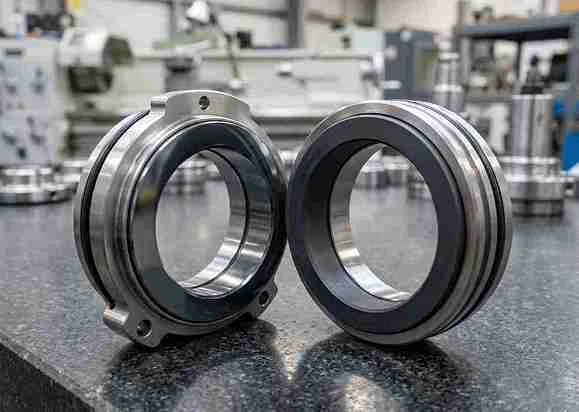

Graphite Rotors Manufacturer
Custom and replacement rotor bodies for applicable dry-running vacuum pumps and compressors, evaluated from drawings, complete dimensions, physical samples and operating conditions.
- Drawing- and sample-based manufacturing
- Rotor slot, bore and interface review
- Application-specific material evaluation
- Inspection before shipment

A Rotor Project Starts with the Complete Pump Design
The term “graphite rotor” does not identify one universal component. Rotor material, geometry and vane interaction vary by pump or compressor design. Some dry-running systems use a carbon graphite rotor, while many others use a metal rotor with graphite vanes.
CARBOLVE evaluates the existing assembly before recommending a manufacturing route. The review considers the rotor body, vane slots, center interface, housing, end plates, operating conditions and the material of the mating vanes.
Product scope: carbon graphite rotor bodies for applicable dry-running vacuum pumps and compressors. This page does not cover brake rotors, electric-motor armatures, turbine rotors or molten-aluminum degassing rotors.
How Can Your Graphite Rotor Project Start?
The most useful starting point depends on whether you are replacing an existing rotor, developing a new assembly or checking the fit between a rotor and its vanes.

Replacement Rotor Manufacturing
For existing or obsolete equipment. Evaluation can begin with an equipment reference, complete rotor dimensions, an engineering drawing or a physical sample.

Custom Rotor from Drawing or CAD
For new equipment and non-standard designs. Geometry, material direction, critical dimensions, operating conditions and inspection requirements are reviewed together.

Rotor-and-Vane Fit Review
For projects where the rotor slots and sliding vanes must be evaluated as one functional system. Include vane dimensions, material information and housing data when available.
Dimensions and Interfaces We Review
A rotor cannot be reproduced reliably from its outside diameter and length alone. Functional interfaces and mating-component data help distinguish nominal geometry from wear, damage or measurement error.

| Review Area | Information to Provide | Why It Matters |
|---|---|---|
| Rotor body | Outside diameter, overall length and end-face profile | Establishes the primary envelope and relationship with the housing and end plates |
| Center interface | Bore, shaft connection, keyway, flats, threads or retaining features | Defines how the rotor is located, driven and assembled |
| Vane slots | Slot quantity, width, depth, angle, position and edge geometry | Influences vane movement, clearance and assembly compatibility |
| Additional features | Grooves, ports, reliefs, counterbores, bolt patterns or custom profiles | Prevents functional details from being omitted during reproduction |
| Mating components | Vane thickness, housing bore, end-plate arrangement and available clearances | Helps evaluate the rotor as part of the complete pumping system |
| Operating data | Speed, temperature, medium, duty cycle, vacuum or pressure condition | Supports material and design review |
| Inspection definition | Drawing datums, critical dimensions, surface requirements and inspection method | Clarifies which characteristics control acceptance |
| Commercial data | Quantity, required documentation and destination country | Supports quotation, packing and delivery evaluation |
For a worn sample, identify any surfaces or dimensions that may have changed in service. A used component is a valuable reference, but it may not represent the original nominal geometry.
Where Graphite Rotor Replacement Projects Commonly Go Wrong
Only the OD and length are copied
Slot geometry, center interfaces and end-face details may still be different. CARBOLVE reviews the complete component and requests mating-part information when it affects fit.
The material is specified only as “graphite”
Graphite materials differ by forming route, grain structure, orientation, strength, thermal behavior and available size. Material selection must follow the application rather than the product color or density alone.
A worn sample is treated as the original specification
Operating wear can change slot width, outside diameter, edges and end faces. Sample measurements should be compared with equipment information, drawings or functional clearances whenever possible.
The rotor and vanes are evaluated separately
Vane thickness, slot condition, sliding behavior and housing geometry can affect the assembly. For a rotor-and-vane project, provide information for both components.

Why Carbon Graphite Is Used in Selected Dry-Running Rotors
When the pump design and operating conditions are suitable, carbon graphite can provide a useful combination of sliding behavior, thermal resistance, dimensional control and machinability. These properties do not make one graphite grade suitable for every rotor.
Self-Lubricating Material Behavior
Selected carbon graphite materials can operate with low-friction sliding behavior in appropriately designed dry-running assemblies.
Machinable Functional Geometry
Slots, bores, grooves, end-face features and custom profiles can be produced from a controlled drawing, subject to material and geometry review.
Thermal and Chemical Considerations
Graphite can suit demanding environments, but temperature must always be evaluated together with atmosphere, process gas, load and exposure time.
Rotor-and-Vane System Compatibility
The rotor material must be considered together with the vane material, housing, end plates, speed and intended duty.
Graphite Rotor Material Selection Goes Beyond Density
Density is only one material property. A practical rotor review also considers the forming route, grain structure, directional behavior, mechanical requirements, thermal environment, purity needs and available blank size.
| Selection Factor | Practical Review |
|---|---|
| Forming route | Isostatic, extruded and molded graphite can have different structures and directional behavior |
| Grain structure | Finer grain may support detailed machining and surface requirements, but does not define the complete grade |
| Material orientation | Directional properties can matter where mechanical load, heat flow or dimensional behavior is critical |
| Strength and geometry | Slot walls, sharp corners, thin sections and center interfaces must be assessed together with the selected material |
| Temperature and atmosphere | Temperature alone is incomplete; oxygen exposure, process gas, duty and component geometry also matter |
| Purity | Higher purity should be specified only when the application requires it and the requirement can be validated |
| Available size | Material route and grade can affect obtainable blank dimensions and economical machining direction |
| Application validation | Final suitability should be confirmed against the intended pump, compressor and operating conditions |
CARBOLVE recommends a material direction only after reviewing the component geometry and application. Do not specify a graphite rotor by density alone.
Carbon Graphite Rotor or Metal Rotor?
Neither material is universally better. The original pump architecture, vane system and operating conditions determine the correct rotor construction.
| Decision Area | Carbon Graphite Rotor | Metal Rotor |
|---|---|---|
| Typical selection basis | Used only in designs developed for a carbon or graphite rotor | Common in many rotary vane systems, including designs using graphite vanes |
| Sliding-system role | Material behavior may support selected dry-running assemblies | Sliding performance depends strongly on vane material, surface condition and pump design |
| Geometry review | Slots, bore, edges and brittle-material design require careful evaluation | Metal geometry and manufacturing rules cannot automatically be transferred to graphite |
| Replacement decision | Confirm the original material and complete assembly before reproduction | Do not replace a metal rotor with graphite solely because graphite vanes are present |
| Correct conclusion | Follow the verified equipment design and application data | Follow the verified equipment design and application data |
A pump that uses graphite vanes does not automatically use a graphite rotor.
Applications for Custom Carbon Graphite Rotors

Dry-Running Rotary Vane Vacuum Pumps
Custom rotor evaluation for pump designs that specifically require a carbon or graphite rotor.

Oil-Free Rotary Vane Compressors
Rotor components reviewed according to compressor geometry, operating pressure, speed, duty and process medium.

Combined Vacuum-Pressure Equipment
Custom rotor projects for applicable equipment that performs both vacuum and pressure functions.

Obsolete and Non-Standard Equipment
Drawing- or sample-based evaluation where the original rotor is no longer readily available or the geometry is non-standard.
Packaging, printing, automation, laboratory and process equipment may use dry-running rotary vane pumps, but the end-use industry alone does not establish the correct rotor material.
Drawing-Based Graphite Machining and Inspection
CARBOLVE manufactures carbon and graphite components for OEM, replacement and maintenance projects. Rotor production is evaluated from the available technical evidence rather than from a generic product name.

1. Technical Input Review
Review the drawing, CAD model, physical sample, equipment reference, dimensions and operating conditions.

2. Material and Manufacturability Review
Evaluate the graphite material direction, blank size, slot geometry, bore, wall sections, edges and critical features.

3. Controlled Machining
Use suitable turning, milling, drilling, boring, slotting, grinding or surface-finishing processes according to the approved component requirements.

4. Inspection and Packing
Complete incoming material review, in-process checks, surface inspection, final verification and protective export packing according to the agreed project scope.
Prepare the Information Needed for Rotor Evaluation
You do not need to have every item before contacting CARBOLVE. However, more complete technical information helps separate confirmed requirements from assumptions.
- Pump or compressor manufacturer and complete model
- Existing part number or equipment reference, if available
- 2D drawing, CAD model, photographs or physical sample
- Rotor OD, length and center-interface dimensions
- Vane slot quantity, width, depth, angle and edge details
- Vane dimensions and material information
- Housing, end-plate or mating-component data when relevant
- Speed, temperature, medium, duty cycle and vacuum or pressure condition
- Critical dimensions, surface and inspection requirements
- Required quantity and destination country
Ready to start?
Gather your available drawings, dimensions or sample photos and contact our engineering team.
Graphite Rotor Selection & Sourcing Guide
What is the difference between a graphite rotor and a graphite vane?
What are the benefits of a carbon graphite rotor in a dry-running pump?
Can CARBOLVE manufacture a replacement rotor from an existing part?
How should a graphite rotor grade be selected?
Is a graphite rotor better than a steel rotor?
How can I evaluate a graphite rotor manufacturer?
What determines the price and delivery schedule for a custom graphite rotor?
What should I send when requesting a graphite rotor quotation?
Related Carbon and Graphite Components

Send Your Rotor Drawing or Existing-Part Details
Request an evaluation for an applicable carbon graphite rotor project. Include the information currently available, and identify any dimensions or material details that still require confirmation.