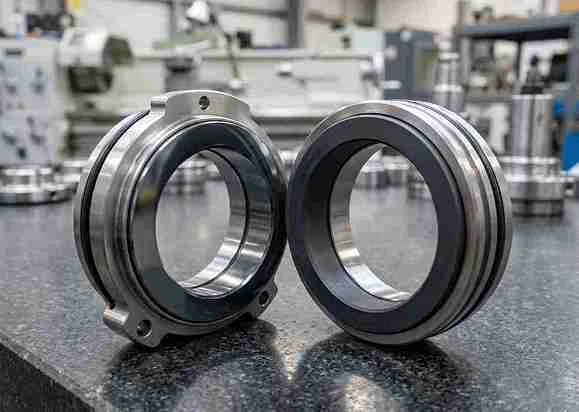

Pump Carbon Seal Rings for Mechanical Sealing Applications
CARBOLVE manufactures one-piece, segmented and custom carbon graphite seal components from drawings, physical samples and application requirements. Material directions are reviewed against the sealed medium, pressure, temperature, shaft speed, mating face and required surface finish.
- One-piece, segmented and custom configurations
- Resin- and metal-impregnated material options
- Drawing- and sample-based manufacturing
- Machining, surface inspection and final verification
Pump Carbon Seal Ring Configurations
Select the ring construction first, then match the carbon grade to the pump, seal design and operating conditions. CARBOLVE evaluates both new components and replacement requirements.

Single-Piece Pump Carbon Seal Rings
Continuous carbon graphite rings and flat or profiled seal faces manufactured to the supplied drawing, dimensions and surface requirements. This configuration is suitable when the seal assembly requires a complete single-piece carbon face.
Select by ring geometry, dimensions, mating face and surface requirements.
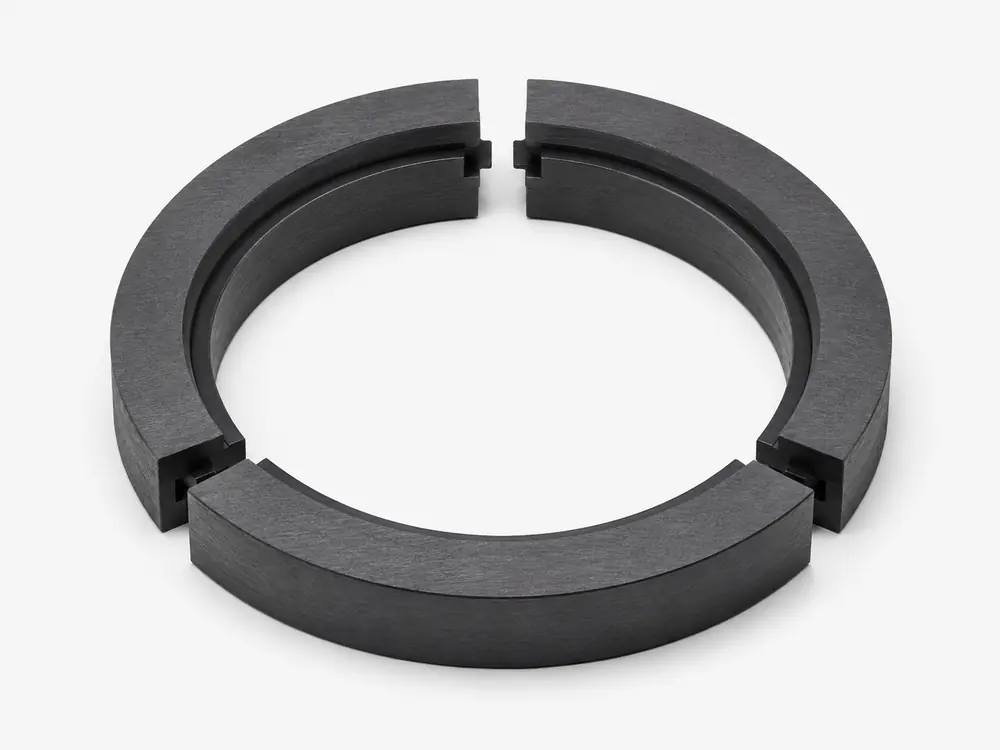
Segmented Carbon Seal Rings for Pumps
Multi-segment carbon ring designs for selected shaft-sealing and large-diameter applications. Segment geometry, assembly arrangement and material direction must be evaluated with the actual equipment and duty conditions.
Select by shaft arrangement, ring diameter, segment design and operating conditions.

Custom and Replacement Pump Seal Components
Carbon rings, seal faces, floating seals and non-standard geometries produced from drawings or physical samples. This route supports new designs, maintenance parts and obsolete replacements that require dimensional verification.
Start with a drawing, complete dimensions, equipment information or a physical sample.
Carbon and Graphite Material Options
CARBOLVE’s engineering material grade system covers resin-impregnated carbon graphite, antimony-impregnated carbon graphite, copper-impregnated carbon graphite, fine-grain carbon, electrographite and selected application-specific grades. Final suitability depends on the complete seal design rather than the grade code alone.
| Material family | CARBOLVE grades | Preliminary selection direction |
|---|---|---|
| Resin-Impregnated Carbon Graphite | CVM-CG-R20, CVM-CG-R30, CVM-CG-HR40 | General pump seals, water or oil service, higher mechanical loads where a resin grade is preferred, and elevated-temperature resin applications |
| Antimony-Impregnated Carbon Graphite | CVM-CG-A20, CVM-CG-A30, CVM-CG-A40 | Steam, light hydrocarbons, high-load and severe-duty mechanical seal directions |
| Copper-Impregnated Carbon Graphite | CVM-CG-C30, CVM-CG-C40 | Applications requiring a higher-pressure or heat-removal material direction |
| Fine-Grain Carbon and Electrographite | CVM-FG-R30, CVM-FG-A40, CVM-EG-U20, CVM-EG-R20 | Precision seal faces, elevated-temperature service and selected dry-running conditions |
| Application-Specific Carbon Grades | CVM-CG-Y30, CVM-CG-PT20, CVM-CG-NC40 and other reviewed grades | Chemical-duty or special operating conditions requiring individual material evaluation |
These grade directions are intended for preliminary material selection. They are not guaranteed specification limits, universal pressure ratings or service-life values. Ring geometry, fit, mating material, PV conditions, cooling, atmosphere and operating medium must also be evaluated.
Start with the Operating Conditions
There is no single carbon grade that is best for every pump seal. Begin with the medium and duty condition, then verify the ring design, counterface and complete seal system.
| Operating need | Initial material direction | Additional factors to verify |
|---|---|---|
| General water, coolant or oil service | CVM-CG-R20 or CVM-CG-R30 | Fluid chemistry, speed, mating face and required leakage control |
| Higher mechanical load with a resin grade preferred | CVM-CG-R30 or CVM-FG-R30 | Ring geometry, fit, surface condition, cooling and PV conditions |
| Elevated-temperature resin service | CVM-CG-HR40 or CVM-FG-R30 | Actual atmosphere, temperature cycle, pressure and cooling |
| Steam, light hydrocarbons or heavy-duty service | CVM-CG-A30 or CVM-CG-A40 | Medium compatibility, pressure, speed and mating material |
| Severe mechanical load or high-speed sealing | CVM-CG-A40 or CVM-FG-A40 | Flatness, alignment, fit, counterface and complete seal loading |
| Higher pressure with heat-removal requirements | CVM-CG-C30 or CVM-CG-C40 | Thermal conditions, geometry, medium and system-level validation |
| Aggressive chemical service | CVM-CG-Y30 or another reviewed grade | Impregnant compatibility, mating materials, leakage requirements and atmosphere |
| High-temperature dry-running service | CVM-EG-U20 or CVM-EG-R20 | Oxidizing or non-oxidizing atmosphere, speed, load and lubrication condition |

Reduce Avoidable Seal Ring Mismatches Before Production
A seal ring can match the nominal dimensions and still be unsuitable for the operating conditions. Material, geometry, fit, mating face and surface requirements need to be reviewed together.
Material selected without the service conditions
Selecting only by a familiar grade name can overlook the medium, temperature, pressure, speed or dry-running condition. CARBOLVE reviews the material direction together with the application data.
Incomplete replacement dimensions
Missing thickness, face geometry, chamfers, grooves or fit information can create an incorrect replacement. Evaluation can begin from a complete drawing, equipment information or a physical sample.
Ring and counterface considered separately
The carbon ring works as part of a sealing pair. Mating-face material, surface condition, alignment, loading and lubrication can influence the final selection.
Inspection requirements defined too late
Critical dimensions, surface condition, identification and packaging requirements should be agreed before production so that the finished parts can be checked against the same purchasing information.
From Application Review to Finished Carbon Components
CARBOLVE combines carbon material direction with drawing- and sample-based component manufacturing. This helps keep the material discussion, geometry, inspection requirements and purchasing information within one project review.
Review the seal function
Confirm the pump or seal model, medium, pressure, speed, temperature and lubrication condition.
Define material and geometry
Review the carbon family, ring dimensions, mating face, fit and required surface finish.
Machine the component
Apply grinding, drilling, slotting and surface-finishing operations according to the agreed component requirements.
Inspect and prepare
Check agreed dimensions, surface condition, identification, quantity and protective packing before dispatch.
Manufacturing and Inspection for Carbon Seal Components
CARBOLVE manufactures industrial carbon and graphite components for equipment manufacturers, distributors and maintenance companies. Projects are evaluated from drawings, physical samples, equipment models, material requirements and operating conditions.
- Incoming material review
- In-process dimensional checks
- Surface and edge inspection
- Final verification against agreed requirements
- Product identification and protective packing
- Technical communication and export documentation
For new designs, obsolete replacements and repeat-order parts, the same approved drawing or sample reference should remain connected to the material direction and inspection requirements.


Pump Carbon Seal Ring Selection and Replacement Guide
Contents
Which material is best for a pump carbon seal ring?
There is no universal best material. Resin-impregnated carbon graphite is a common starting direction for general pump, water and oil service. Antimony- or copper-impregnated grades may be evaluated where mechanical load, pressure or heat transfer changes the requirement. Fine-grain carbon and electrographite provide additional directions for precision, elevated-temperature or selected dry-running applications.
The final choice must also consider the fluid or gas, ring design, mating face, pressure, speed, temperature, lubrication, corrosion conditions and required leakage control.
How can a worn carbon seal ring be identified?
Possible warning signs include increasing leakage, visible scoring, chipped edges, cracks, abnormal wear, loss of face condition, unusual heat, vibration or noise. These symptoms do not automatically prove that the carbon ring is the only cause.
Inspect the complete sealing assembly, including the mating face, alignment, loading components, lubrication condition and contamination, before specifying a replacement.
What commonly causes premature carbon seal ring failure?
Common causes include an unsuitable material or impregnation direction, abrasive contamination, operation outside the intended lubrication condition, misalignment or runout, incorrect fit, installation damage, thermal shock, excessive heat and a damaged or unsuitable counterface.
Failure analysis should consider the wear pattern and operating history rather than replacing the ring by dimensions alone.

Typical face wear evaluation
What should be checked before installing a replacement ring?
Verify the part identification, dimensions, orientation and mating components before assembly. Keep the seal faces clean, inspect them for chips or cracks and protect carbon edges from impact. Do not force the ring into an incorrect fit.
Follow the pump or seal manufacturer’s specified assembly, lubrication, loading and commissioning procedure. Installation requirements vary with the seal design, so a general procedure should not replace the equipment documentation.
What information defines a pump carbon seal ring specification?
A complete specification normally includes the ring drawing or dimensions, seal type, mating-face material, operating medium, pressure, shaft speed, temperature, lubrication condition, dry- or wet-running state, corrosion requirements, leakage requirements and quantity.
CARBOLVE grade codes identify the base carbon family, impregnation or treatment and grade position. A grade number does not by itself state density, metal content, pressure capability or equivalence to another manufacturer’s grade.
How should carbon seal ring suppliers be compared?
Compare more than the quoted ring dimensions. Ask how the supplier reviews the material family, replacement reference, mating face, operating conditions, critical dimensions and surface requirements. Confirm which inspections, identification and packing requirements will be recorded for the order.
Supplier or brand comparisons should be based on documented product scope, material information, drawing or sample review, inspection checkpoints and communication—not unsupported rankings or generic quality claims.
Discuss Your Pump Carbon Seal Ring Requirement
Share the available drawing, dimensions, equipment or seal model and operating conditions. This information supports a more focused review of the ring construction, carbon material direction and manufacturing requirements.
Direct Contact Support
sales@carbolve.com
+86(513)-81100106