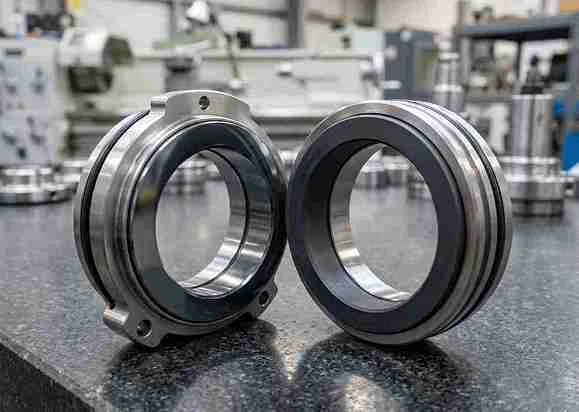
Mechanical Seal Faces Manufacturer
CARBOLVE manufactures precision carbon graphite mechanical seal faces according to engineering drawings, physical samples, dimensions, material grades, and operating conditions. We supply rotary faces, stationary faces, carbon seal rings, and custom lapped inserts for pumps, mixers, agitators, and reactors.
*CARBOLVE primarily supplies carbon and graphite sealing components rather than complete mechanical seal assemblies unless otherwise verified.
Send the drawing, seal-face dimensions, carbon grade if known, mating-face material, process fluid, temperature, pressure, speed, seal model, and required quantity.

Which Mechanical Seal Face Components Does CARBOLVE Manufacture?
This page refers to the precision-lapped primary sealing faces used in end-face mechanical seals. It does NOT primarily refer to Duo Cone seals or heavy-duty metal face seals.
CARBOLVE Product Focus
- Carbon graphite mechanical seal faces
- Carbon seal rings
- Carbon rotary faces
- Carbon stationary faces
- Carbon face inserts
- Custom carbon sealing rings
- Lapped carbon faces where verified
- Replacement carbon seal faces
- Drawing/sample-based products
Related Mechanical Seal Components
Explain but do not claim supply unless verified:
- Silicon carbide mating rings
- Tungsten carbide faces
- Ceramic faces
- Metal holders, springs, elastomers, glands, sleeves
- Complete seal assemblies
Carbon & Graphite
Products Manufacturer
Drawing & Sample
Evaluation
Custom Geometry
Seal Face Machining
Precision Machining
To Specification
Dimensional Inspection
Face Verification
Mechanical Seal Faces by Project Requirement

Carbon Graphite Seal Faces
Primary CARBOLVE product direction for industrial sealing applications.

Rotary Carbon Seal Faces
For seal designs where carbon acts as the rotating ring.

Stationary Carbon Seal Faces
For designs where carbon is the stationary mating ring.

Carbon Seal Face Inserts
For inserted-face designs where verified manufacturing is applicable.

Custom Lapped Rings
Precision finished surfaces only where lapping capability is verified.

Replacement Seal Faces
From drawing, part number, physical sample, or dimensions.

Obsolete Seal Faces
Custom reproduction for discontinued equipment based on evaluation.

Custom Face Geometry
Machining for grooves, slots, ports, and drive features per drawing.
What Are Mechanical Seal Faces?
Mechanical seal faces are precision-finished annular surfaces that form the primary dynamic sealing interface in an end-face mechanical seal. One face usually rotates with the shaft while the opposing face remains stationary, allowing the machine shaft to rotate while controlling process-fluid leakage.
The working interface normally consists of:

How Do Mechanical Seal Faces Work?

-
One seal face rotates with the shaft.
-
The opposing face remains stationary.
-
Mechanical and hydraulic closing forces keep the faces in the intended relationship.
-
A thin lubricating film develops between the operating faces according to the seal design.
-
The film provides lubrication and helps remove heat.
-
Precision face geometry limits leakage while allowing rotation.
Performance depends on: Face materials, flatness, surface condition, fluid film, face loading, pressure, speed, temperature, process fluid, and seal support system.
Mechanical Seal Face Anatomy

*Not all features are present on every product.
Rotary vs Stationary Mechanical Seal Faces
| Factor | Rotary Face | Stationary Face |
|---|---|---|
| Motion | Rotates with shaft | Fixed relative to housing |
| Seal interface | Yes | Yes |
| Carbon possible? | Yes, design dependent | Yes, design dependent |
| Drive feature | May be required | Anti-rotation may be required |
| Mounting | Seal-design specific | Seal-design specific |
| Material | Application specific | Application specific |
Carbon is not automatically designated to one specific side. It depends entirely on the mechanical seal design.
Seal Ring vs Mating Ring
Terminology varies between seal designs and manufacturers. A mechanical seal face pair may be described as:
- Seal ring + mating ring
- Primary ring + counterface
- Rotary ring + stationary ring
When requesting a quote, identify which ring rotates and which remains stationary whenever possible, rather than relying on terms that may not be perfectly interchangeable.
Why Carbon Graphite Is Used for Mechanical Seal Faces
A suitable carbon graphite grade may offer specific engineering advantages depending on the application and seal design.
Favorable Sliding Behavior
Self-lubricating characteristics under marginal conditions.
Counterface Compatibility
Ability to operate effectively against hard counterfaces.
Controlled Sacrificial Wear
Often designed to wear preferentially to save the hard face.
Precision Machinability
Can be machined for complex geometry and lapped flat.
*Properties such as chemical resistance, thermal behavior, and dry-running capability are highly grade and application dependent.
Common Mechanical Seal Face Materials
Carbon / Carbon Graphite
CARBOLVE core product focus. Available in verified grades for various applications.
Silicon Carbide
A common hard counterface material known for hardness and thermal properties.
Tungsten Carbide
Another hard face material used in demanding or high-impact services.
Alumina Ceramic
Used as a hard mating face in selected general mechanical seal applications.
Carbon Graphite Material Options
| Material Direction | General Engineering Consideration | Verification Needed |
|---|---|---|
| Resin-Impregnated Carbon | Impregnation affects permeability, chemistry and temperature behavior | Exact grade |
| Metal-Impregnated Carbon | Can change strength/thermal/tribological behavior | Metal + application |
| Other Mechanical Carbon | Grade-specific characteristics | Material data |
Mechanical Seal Face Material Combinations
| Face Pair | General Application Direction | Main Considerations |
|---|---|---|
| Carbon / Silicon Carbide | Common engineering combination | Fluid, solids, heat, chemistry |
| Carbon / Tungsten Carbide | Selected demanding services | Impact, wear, chemistry, friction |
| Carbon / Ceramic | Selected general applications | Fluid, temperature, thermal shock |
| SiC / SiC | Selected abrasive/high-solids services | Lubrication, thermal behavior |
The mechanical seal face material is a face-pair decision, not a single-material decision.
Comparing Face Materials
Carbon vs Silicon Carbide
They are often complementary rather than competing. Carbon is generally softer, offers useful self-lubricating behavior, and acts as a sacrificial face. Silicon carbide is hard, wear-resistant, and provides strong thermal and chemical resistance. It is often a face-pair decision.
Carbon vs Tungsten Carbide
Compare cautiously based on hardness, mechanical robustness, friction, abrasive resistance, and thermal behavior. Tungsten carbide may be selected for high-impact or specific chemical environments where its binder is compatible.
Carbon vs Ceramic
Alumina ceramic may be used as a hard mating face in selected seal designs. Selection must weigh ceramic's hardness against its brittleness and thermal shock sensitivity in the specific chemical environment.
How Are Mechanical Seal Face Materials Selected?
Process Fluid
- • Fluid name & concentration
- • Viscosity & lubricity
- • Vapor pressure
Solids & Abrasives
- • Solids present?
- • Concentration & size
- • Abrasiveness
Operating Conditions
- • Temperature (Normal/Max)
- • Pressure (Chamber/Diff)
- • Shaft RPM / Surface Speed
Seal Design
- • Rotary/stationary
- • Single/double
- • Flush/support arrangement
Existing Failure Analysis
- • Wear or scoring
- • Blistering or heat damage
- • Cracks or leakage
Mechanical Seal Face Specifications
Identification
Seal manufacturer, seal model, equipment, OEM part number, carbon grade, mating-face material.
Dimensions
OD, ID, axial length, working-face width, step diameter/depth, grooves, slots, holes, ports, chamfers, radii.
Geometry
Flatness, parallelism, concentricity, squareness, surface finish (according to approved drawing).
How to Measure a Mechanical Seal Face
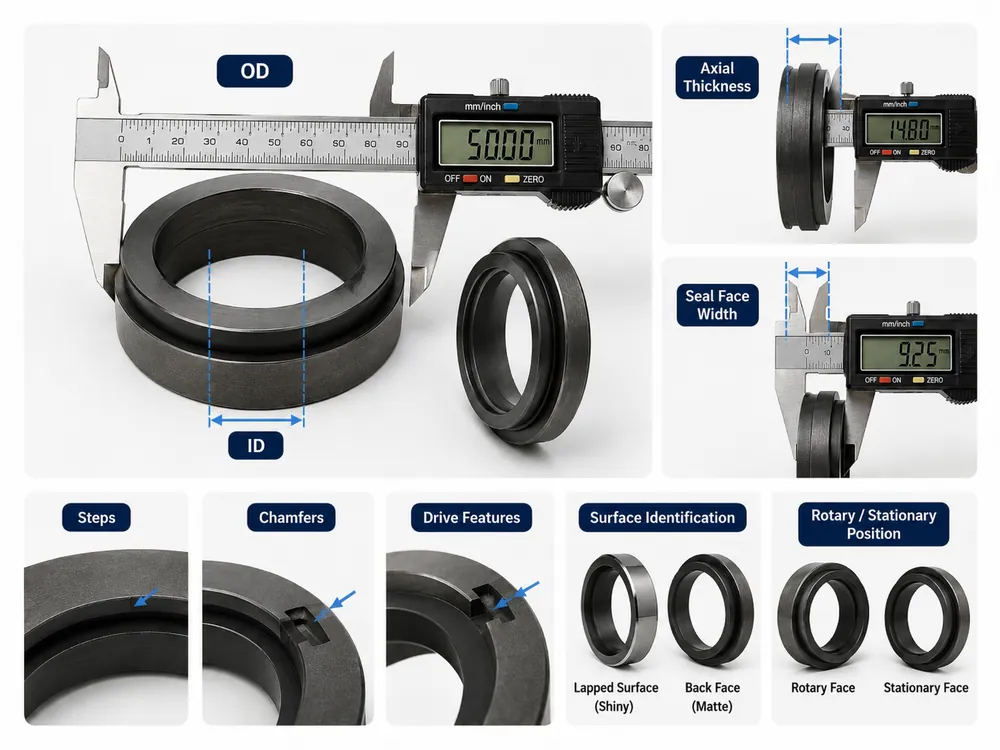
Measure OD, ID, axial thickness, seal-face width, steps, chamfers, and drive features. Also record which surface is lapped, rotary/stationary position, and mating material.
Important: Do not measure only the worn sealing track and assume it represents the original design.

Why Mechanical Seal Face Flatness Matters
The face pair relies on highly controlled geometry. Excessive face distortion can contribute to uneven contact, local heat, excessive leakage, wear, and an unstable fluid film.
What Are Light Bands?
Light bands are optical interference fringes observed between a precision reference surface (optical flat) and the seal face under suitable monochromatic light. They are used to evaluate flatness, shape deviation, and lapping quality. Seal-face flatness should follow the approved drawing or customer specification.
Mechanical Seal Face Lapping
Lapping is a precision finishing process used to establish a very flat and controlled working face, improving flatness and preparing the sealing surface. [Insert verified CARBOLVE lapping capability].
Surface Finish
Flatness and surface finish are related but not identical parameters. Buyers should specify the required lapped surface finish and inspection method according to the drawing.
Custom Features & Grooves
Where verified, CARBOLVE machines drive slots, anti-rotation slots, holes, ports, and custom profiles. Special hydrodynamic face patterns must follow an approved engineering design.
Custom Manufacturing Workflows
Manufacturing From Your Drawing
- Receive drawing and confirm revision/units.
- Confirm carbon material and mating material.
- Review OD, ID, thickness, and working face.
- Review flatness and surface finish requirements.
- Review custom grooves, holes, or slots.
- Confirm application and inspection requirements.
- Manufacture according to approved specification.
Manufacturing From a Physical Sample
- Receive sample and identify rotary/stationary position.
- Measure dimensions and inspect working surface/wear track.
- Identify material where possible.
- Request mating-face and application data.
- Determine missing original dimensions.
- Create proposed specification for customer validation.
- Repeat production where necessary.
What a Worn Mechanical Seal Face May Not Tell Us
Usually Still Visible
- • OD, ID, Thickness
- • Basic geometry, slots, holes
- • Mounting style & markings
- • Wear pattern
May Be Unknown
- • Original sealing-face flatness & finish
- • Original sealing band dimensions
- • Exact carbon grade & impregnation
- • Original interference fit
A worn mechanical seal face is useful for identification but is not necessarily a complete engineering specification.
Mechanical Seal Face Troubleshooting Guide
| Symptom | Possible Contributors | What to Check |
|---|---|---|
| Leakage | Face damage, distortion, secondary seal, installation | Complete seal system |
| Rapid carbon wear | Abrasives, material mismatch, counterface, heat | Face pair & fluid |
| Scoring | Solids, debris, damaged mating face | Fluid + surfaces |
| Blistering/cratering | Material, impregnation, thermal/fluid effects | Carbon + process |
| Face cracking | Stress, impact, thermal shock, fit, vibration | Component + assembly |
| Overheating | Dry running, poor film, cooling/flush issue | Seal support system |
Seal-face damage can originate from bearings, shaft movement, vibration, alignment, process conditions, flush systems, installation, secondary seals, and other mechanical seal components. Visual appearance alone is not a complete root-cause diagnosis.
Why Work With CARBOLVE?
Carbon & Graphite Focus
CARBOLVE focuses strictly on industrial carbon/graphite components, providing specialized material knowledge.
Drawing & Sample Evaluation
Projects start from actual technical documentation or physical parts, ensuring accurate reproduction.
Custom Geometry & Machining
Support for specific OD/ID, steps, slots, holes, grooves, and chamfers according to your drawing.
Verified Manufacturing Evidence
Material Evidence
- • Actual carbon materials
- • Material identification
- • Supplier data sheets
- • Material certificates where available
Manufacturing Evidence
- • Carbon turning & grinding
- • Slot & hole machining
- • Face finishing
- • Lapping where verified
Inspection Evidence
- • OD/ID & thickness measurement
- • Flatness & surface inspection
- • Optical flat where verified
- • Dimensional reports
What Information Is Needed for a Quote?
Not every item is required for every inquiry. Send all information currently available and CARBOLVE can identify the additional information required.
- Component: Rotary/stationary face, seal ring, mating ring, insert.
- Identification: Seal/equipment manufacturer, model, OEM part number.
- Documentation: Engineering drawing, physical sample, photos.
- Materials: Carbon grade, impregnation, mating-face material.
- Dimensions: OD, ID, thickness, face width, slots, grooves.
- Geometry: Flatness, surface finish, lapping requirement.
- Operating Data: Fluid, solids, temperature, pressure, RPM.
Direct Contact
Email: sales@carbolve.com
Phone: +86(513)-81100106
Address: No.1, Taoyuan Road, Nantong City, Jiangsu Province, China
Request a Mechanical Seal Face Quote
Frequently Asked Questions
Are mechanical seal faces always in contact?
Can carbon mechanical seal faces run dry?
Which is better: carbon or silicon carbide?
How flat should a mechanical seal face be?
Can CARBOLVE reproduce a worn mechanical seal face?
What causes mechanical seal leakage?
Does CARBOLVE manufacture complete mechanical seals?
What is the difference between mechanical seal faces and metal face seals?
Need Carbon Graphite Mechanical Seal Faces?
Provide your drawing, physical sample, seal manufacturer model, OEM part number, dimensions, mating-face material, and process conditions. CARBOLVE will evaluate your requirement for custom precision manufacturing.