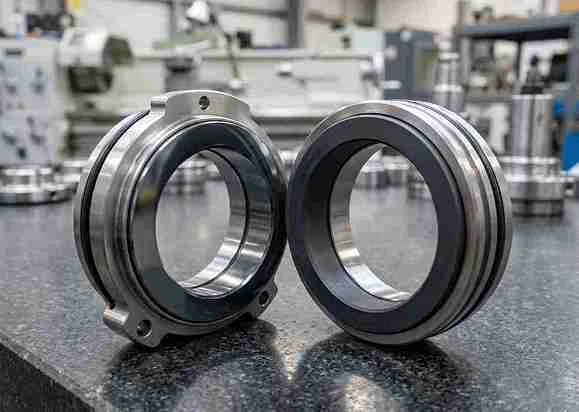

Compressor Carbon Seal Rings for Industrial Sealing Applications
CARBOLVE manufactures carbon graphite rings, seal faces and custom components for compressor sealing applications. One-piece, segmented, floating and replacement configurations are evaluated from drawings, physical samples, equipment information and operating conditions.
- One-piece and segmented carbon ring configurations
- Custom floating-ring and replacement components
- Resin- and metal-impregnated material directions
- Drawing-based machining and inspection
Compressor Carbon Seal Ring Configurations
The ring construction must match the compressor seal arrangement before a carbon grade is selected. Compare the component form, movement, mating surface and available replacement information.

Compressor Carbon Mechanical Seal Rings & Faces
Single-piece carbon graphite rings and flat or profiled seal faces manufactured to the supplied drawing, dimensions and surface requirements. Use this route when the compressor seal assembly requires a continuous carbon ring or mechanical seal face.
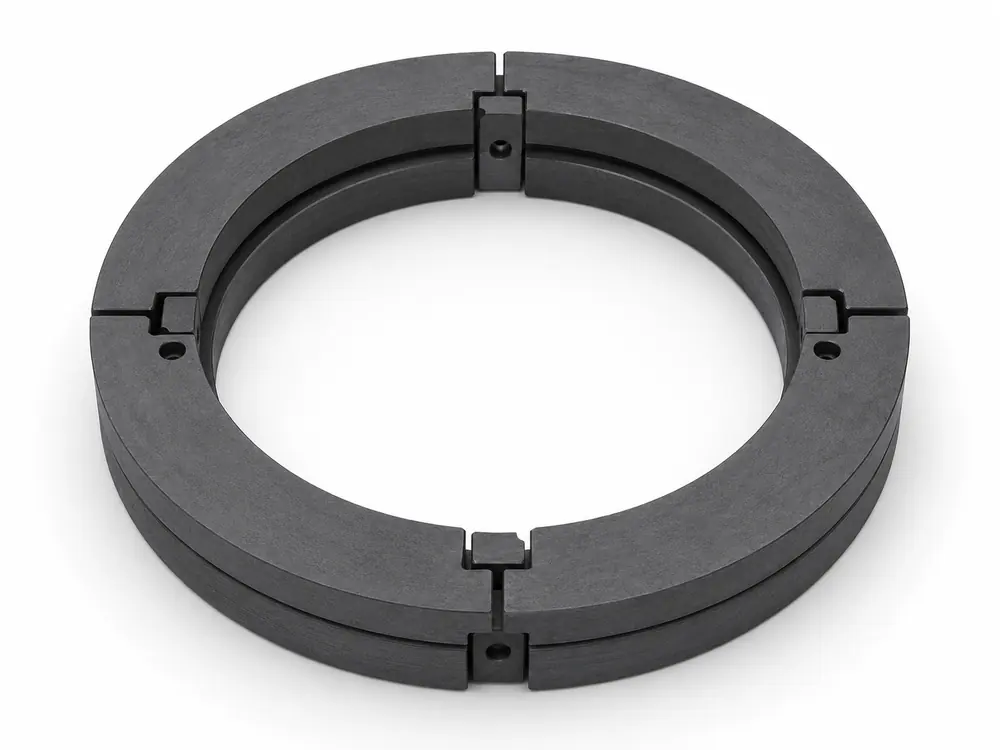
Segmented Compressor Carbon Seal Rings
Multi-segment carbon ring components for selected compressor shaft-sealing arrangements. Segment geometry, joint arrangement, running clearance and material direction must be evaluated with the compressor design and operating conditions.

Floating Carbon Seal Rings for Compressors
Custom floating carbon ring components manufactured from drawings or samples for seal arrangements that allow controlled radial movement or close-clearance operation. Housing, shaft or sleeve condition and the complete sealing arrangement remain part of the application review.

Custom & Replacement Compressor Carbon Components
Carbon rings, seal faces and non-standard components produced from drawings, physical samples or equipment information. This route supports new designs, maintenance parts and obsolete replacements that require dimensional verification.

How Carbon Rings Work Inside a Compressor Seal
A compressor carbon seal ring acts as a functional sealing or restriction element between moving and stationary parts. Depending on the seal design, it may operate as a contacting face, a segmented shaft ring or a close-clearance floating component.
The ring helps control gas or oil migration and limit leakage between pressure zones. Its behavior is determined by the complete assembly, including ring geometry, running clearance, pressure balance, housing, shaft or sleeve condition, mating surface, loading arrangement and lubrication or buffer-gas conditions.
CARBOLVE supplies carbon rings, seal faces and custom components. Final validation of the complete compressor seal assembly remains with the equipment or seal-system designer.
Choose the Ring Construction Before the Grade
| Configuration | Practical distinction | Typical starting situation | Key information required |
|---|---|---|---|
| Mechanical seal ring or face | Continuous carbon ring with a flat or profiled sealing surface | A compressor mechanical seal assembly requiring a carbon face or complete ring | Drawing, dimensions, mating face, pressure, speed and surface requirements |
| Segmented carbon ring | Multiple carbon segments assembled around a shaft or sleeve | Shaft sealing where a split or multi-segment arrangement is required | Shaft diameter, segment geometry, joints, clearance, gas and temperature |
| Floating carbon ring | Ring permitted to move within a defined housing and clearance arrangement | Custom close-clearance or floating-ring seal designs | Housing drawing, shaft or sleeve condition, radial clearance and pressure zones |
| Custom replacement component | Existing carbon component reproduced or revised from technical evidence | Maintenance, obsolete parts or equipment without a current standard part | Drawing, physical sample, photographs, equipment model and measured dimensions |
Similar outside dimensions do not mean that two compressor carbon rings are interchangeable. Confirm the ring function, segment or joint arrangement, mating components, clearances and material before ordering a replacement.
Carbon and Graphite Material Options
CARBOLVE’s engineering grade system covers resin-impregnated carbon graphite, antimony-impregnated carbon graphite, copper-impregnated carbon graphite, unimpregnated carbon, fine-grain carbon, electrographite and selected application-specific treatments.
A compressor carbon grade cannot be selected by temperature or pressure alone. The gas, lubrication condition, ring construction, shaft speed or reciprocating motion, leakage requirement, atmosphere and mating materials must be reviewed together.
| Material family | CARBOLVE grades | Preliminary material direction |
|---|---|---|
| Resin-Impregnated Carbon Graphite | CVM-CG-R20, CVM-CG-R30, CVM-CG-HR40 | General mechanical seal, higher-load resin and elevated-temperature resin directions |
| Antimony-Impregnated Carbon Graphite | CVM-CG-A20, CVM-CG-A30, CVM-CG-A40 | Steam, light hydrocarbon, high-load and severe-duty seal directions |
| Copper-Impregnated Carbon Graphite | CVM-CG-C30, CVM-CG-C40 | Applications requiring a higher-pressure or heat-removal material direction |
| Unimpregnated Carbon Graphite | CVM-CG-U10 | Segmented-ring or selected porous-service directions |
| Electrographite | CVM-EG-U20, CVM-EG-R20 | Elevated-temperature and selected dry-running ring or bearing directions |
| Fine-Grain Carbon Graphite | CVM-FG-R30, CVM-FG-A40 | Precision seal-face and severe-duty material directions |
| Application-Specific Grades | CVM-CG-Y30, CVM-CG-PT20, CVM-CG-NC40... | Chemical-duty or special operating conditions requiring individual evaluation |
These grade directions support preliminary material selection. They are not guaranteed specification limits, universal compressor pressure ratings or service-life values. Final suitability depends on the actual ring geometry, fit, mating surface, PV conditions, atmosphere, cooling and operating medium.
Eight Conditions That Define the Material and Ring Design
Gas or operating medium
Confirm the gas composition, oil exposure, moisture, contaminants and chemical compatibility requirements.
Pressure and pressure differential
Review the pressure on each side of the ring and the required leakage-control direction.
Motion and speed
Identify whether the mating component rotates or reciprocates and provide the applicable speed information.
Temperature and atmosphere
State the operating and transient temperatures and whether the environment is oxidizing, inert or otherwise controlled.
Lubrication condition
Clarify whether the ring runs with oil, another lubricant, a process film, buffer gas or under an intended dry-running condition.
Shaft, rod or sleeve condition
Confirm the mating material, diameter, surface condition, runout and any existing wear.
Ring construction and clearance
Define the one-piece, segmented or floating arrangement, including joints, gaps, fits and housing geometry.
Leakage and inspection requirements
State the intended sealing function and the dimensions, surface conditions and verification points required for the component.
A universal grade recommendation without these conditions can create a misleading specification. CARBOLVE uses the available operating data to review a material direction and manufacturing requirement for the carbon component.
Reduce Avoidable Seal Ring Mismatches Before Production

Selecting by grade name alone
Two grades described as carbon or graphite can differ in base material, impregnation and intended duty. CARBOLVE reviews the grade family together with the compressor conditions and ring geometry.
Copying dimensions without the seal function
A replacement may match the diameter and thickness but still have the wrong joint, clearance, face profile or fit. Drawings and samples should be evaluated with the position and function of the ring.
Ignoring the mating component
A worn shaft, rod, sleeve or counterface can affect the behavior of a new carbon ring. Mating material, surface condition, alignment and runout should be checked as part of the replacement decision.
Defining inspection requirements after machining
Critical dimensions, surface condition, identification and packaging requirements should be agreed before production so that the finished components can be verified against the same purchasing information.
From Compressor Information to Finished Carbon Components
CARBOLVE coordinates material direction, component geometry, machining requirements and inspection information within one project review. Production can be evaluated from a technical drawing, physical sample, equipment model, photographs and operating conditions.
Identify the ring and its function
Review the compressor or seal reference, position in the assembly and available technical information.
Confirm geometry and material direction
Define dimensions, joints, clearances, mating surfaces, carbon family and surface requirements.
Machine and finish the component
Apply grinding, drilling, slotting and surface-finishing operations according to the agreed geometry.
Inspect and prepare the order
Check agreed dimensions, surface condition, quantity, identification and protective packing before dispatch.
This approach supports new compressor designs, maintenance parts, obsolete replacements and repeat-order components without assuming that visually similar rings are interchangeable.
Manufacturing and Inspection for Carbon Seal Components
CARBOLVE manufactures industrial carbon and graphite components for equipment manufacturers, distributors and maintenance companies. Compressor seal ring projects are reviewed from the component requirements rather than from the product name alone.
- Incoming material review
- In-process dimensional checks
- Surface and edge inspection
- Final verification against agreed requirements
- Product identification and protective packing
- Technical communication and export documentation
For replacement and repeat-order parts, keep the approved drawing or sample reference connected to the material direction, inspection requirements and product identification.

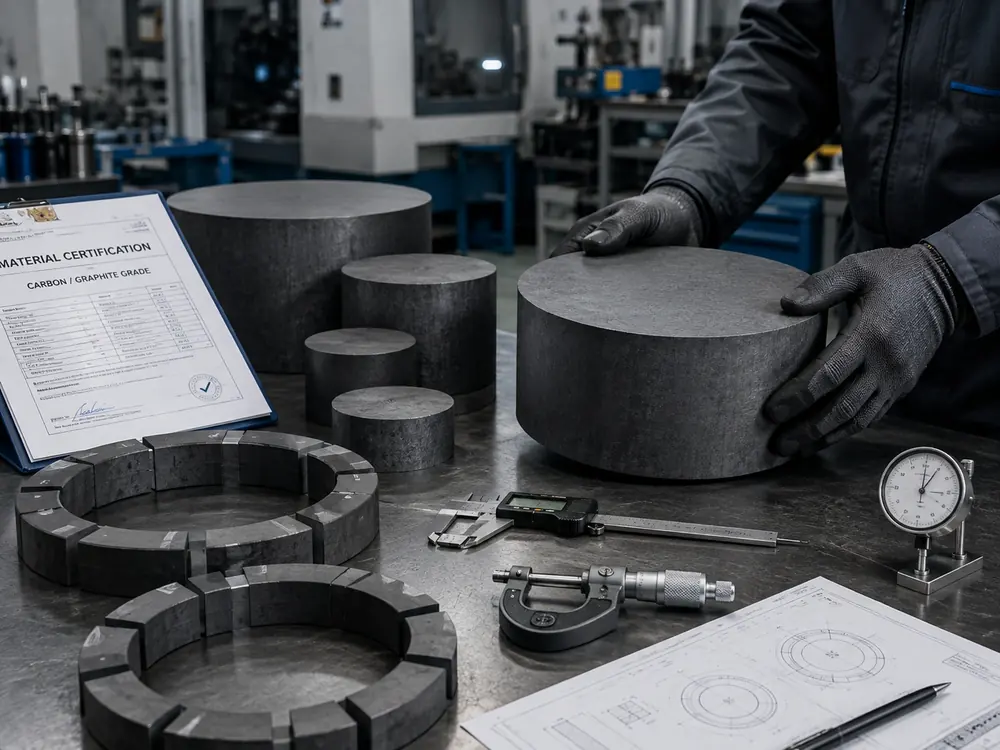


Compressor Carbon Ring Selection and Replacement Guide
What is the primary function of a carbon seal ring in a compressor?
A carbon ring controls or restricts gas, oil or process-medium leakage between moving and stationary parts. Depending on the compressor seal design, it may work as a mechanical seal face, segmented shaft ring or floating close-clearance component.
The carbon ring is only one part of the sealing arrangement. Clearances, pressure balance, housing, mating surfaces, loading, lubrication and buffer-gas conditions also determine the result.
Which compressor carbon seal ring is the best choice?
The best choice is the ring that matches the existing seal construction and operating conditions. First identify whether the assembly requires a one-piece face, segmented ring, floating ring or non-standard replacement. Then compare the gas, pressure differential, motion, speed, temperature, atmosphere, lubrication and mating components.
Supplier rankings or generic ‘best material’ claims cannot replace this application review.
What are common signs of wear or failure?
Possible warning signs include increasing leakage, visible scoring, polished or uneven wear areas, chipped segments, cracks, abnormal gaps, excessive carbon dust, heat, vibration or noise. These symptoms can also originate from the shaft, sleeve, housing, alignment, loading or operating conditions.
Inspect the complete sealing position and record the wear pattern before ordering a replacement.
Why can compressor seal performance change after ring replacement?
A new ring may behave differently if its material, impregnation, joint geometry, clearance, surface condition or fit does not match the original design. Existing shaft or sleeve wear, contamination, alignment and changes in compressor duty can also affect the sealing interface.
Matching only the outside diameter, inside diameter and thickness is therefore insufficient for many segmented or floating-ring replacements.
What should be checked before installing carbon rings in a reciprocating compressor?
There is no universal installation sequence for every reciprocating compressor. Follow the compressor or packing manufacturer’s instructions and verify the ring sequence, segment orientation, joint arrangement, specified clearances, spring or loading components and rod condition where applicable.
Keep the parts clean, protect carbon edges from impact and do not force a ring into an incorrect fit. Do not install visibly chipped or cracked components. When the original sequence or orientation is unknown, obtain the equipment documentation before assembly.
What information is needed for a replacement carbon seal ring?
Provide the compressor manufacturer and model when available, the ring location, complete dimensions, photographs, drawing or physical sample, existing grade or markings, shaft or rod information, gas or medium, pressure, speed, temperature, lubrication condition and quantity.
For segmented components, also record the number of segments, joint form, gaps, grooves, locating features and assembly orientation.
How should compressor carbon seal ring suppliers be compared?
Compare the supplier’s actual product scope, material-grade information, drawing or sample review, ability to distinguish one-piece, segmented and floating components, machining processes, inspection checkpoints, identification and packing practices.
Do not base the decision only on a brand ranking, a broad pressure claim or an unexplained material description. The quotation should refer to an identifiable drawing, sample or technical requirement.
Discuss Your Compressor Carbon Seal Ring Requirement
Share the available drawing, sample, compressor information and operating conditions. This supports a focused review of the ring construction, carbon material direction and manufacturing requirements.