Carbon Seal Ring Manufacturer
CARBOLVE manufactures precision carbon graphite seal rings for mechanical seals, pumps, compressors, mixers, and turbines. We support drawing-based and sample-based production for mechanical face seal rings, segmented carbon rings, OEM designs, and replacement parts according to confirmed operating conditions.
- Custom Carbon Seal Ring Manufacturing
- Mechanical Face & Segmented Ring Options
- Drawing and Sample-Based Production
- Precision Machining and Finishing
- OEM and Replacement Support
Send the drawing, dimensions, equipment model, sealed medium, temperature, pressure, speed, existing material, and required quantity for evaluation.
Carbon Seal Rings Manufactured for Industrial Equipment
Seal-ring material, geometry, dimensions, surface condition, mating face, and operating environment affect leakage control, heat generation, friction, and wear. CARBOLVE manufactures specific components to meet these demands.
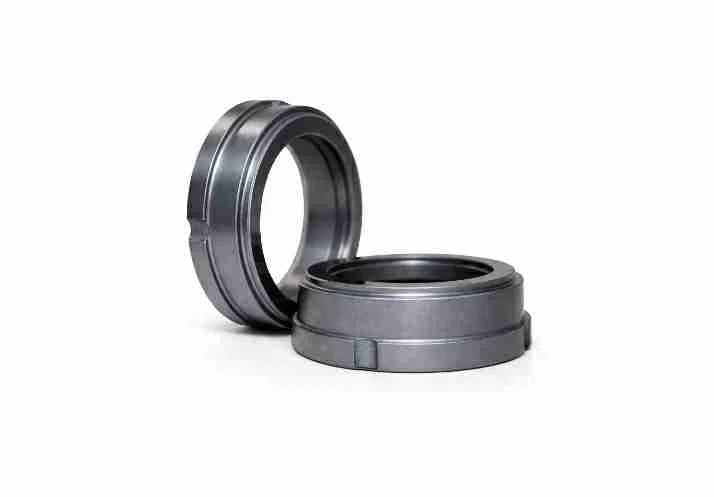
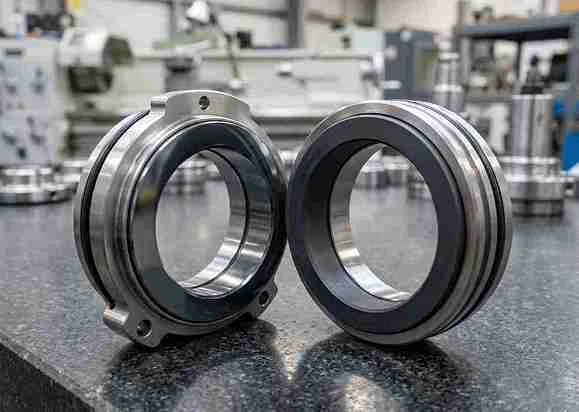
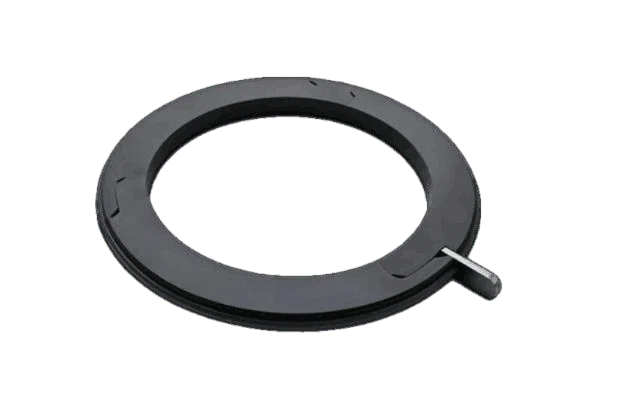
Mechanical Face Seal Rings
- • Solid carbon graphite seal faces
- • Stationary or rotating ring designs
- • Flat sealing faces
- • Grooves, slots, notches, or ports
- • Drawing and sample-based production
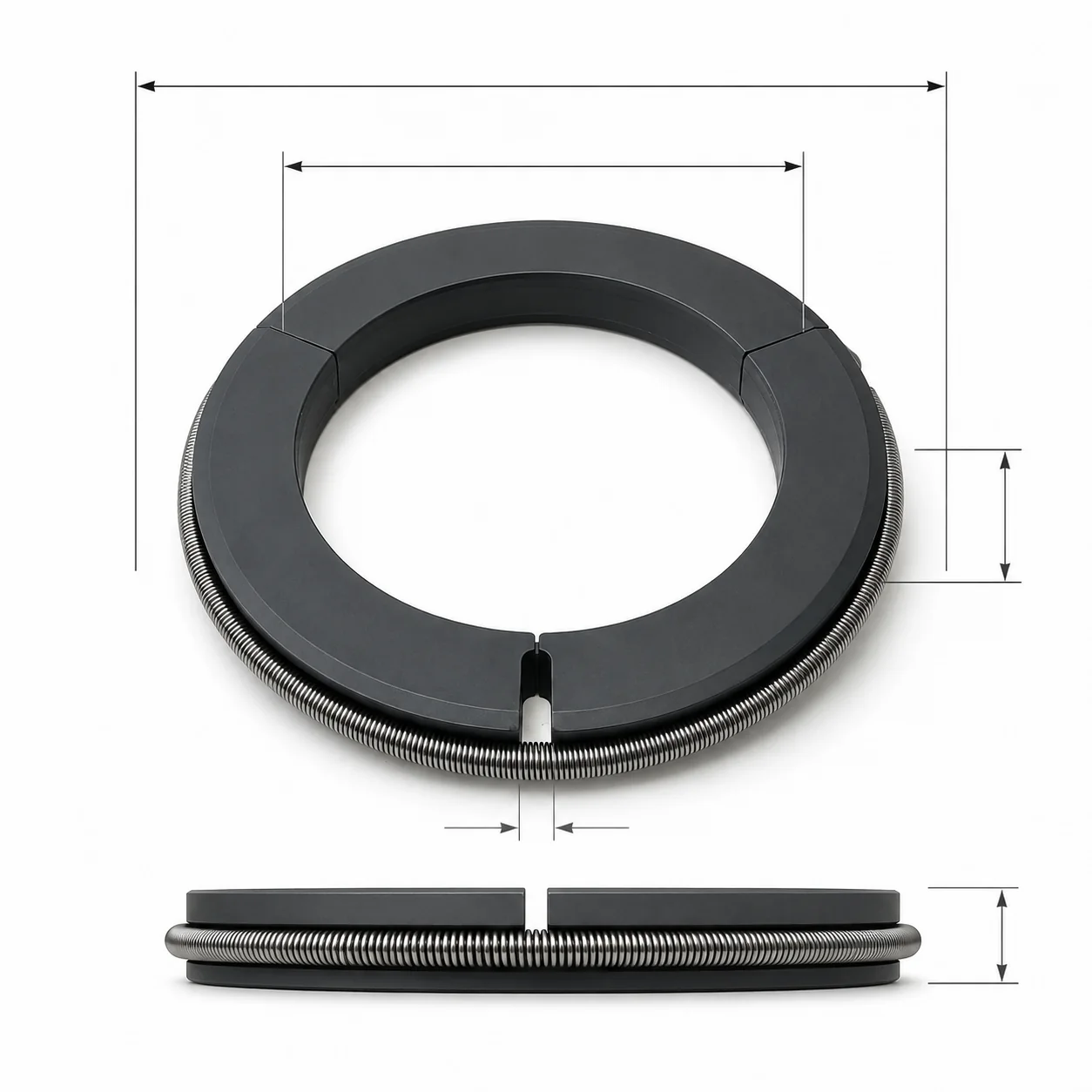
Segmented Carbon Seal Rings
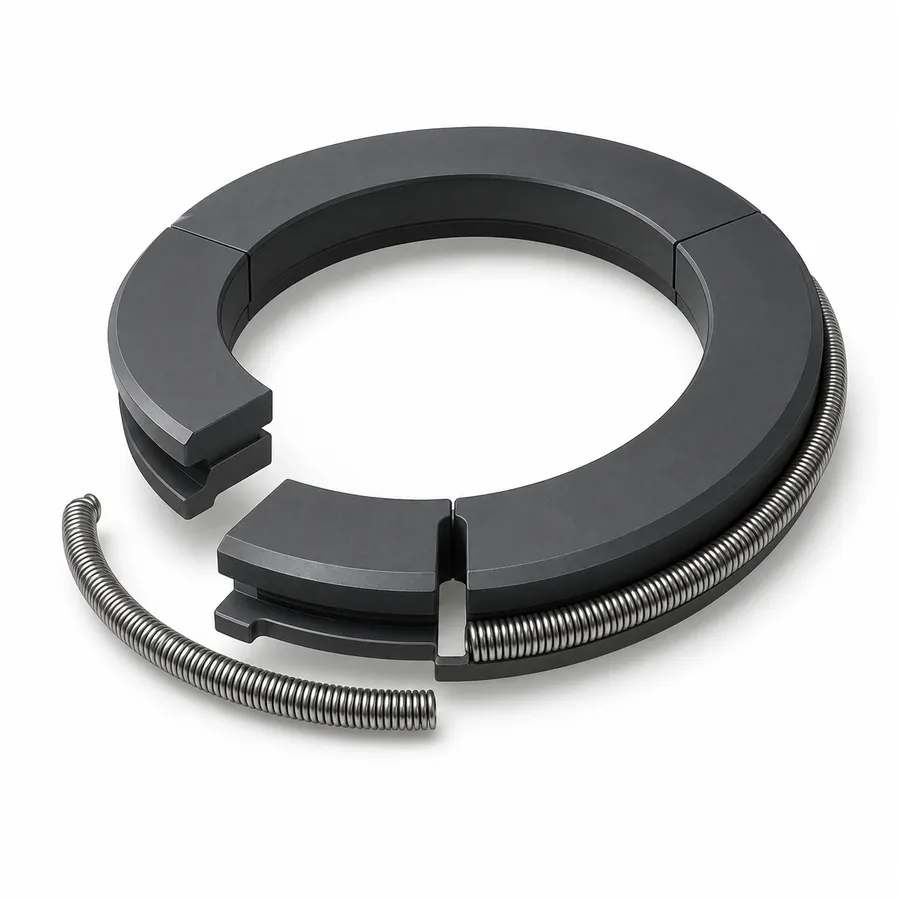
- • Split and multi-segment rings
- • Shaft-sealing applications
- • Segment joints
- • Spring grooves
- • Custom inside and outside diameters

Replacement Carbon Seal Rings
- • Existing equipment model evaluation
- • Original part number review
- • Worn sample reproduction
- • Product photograph analysis
- • Dimensional confirmation
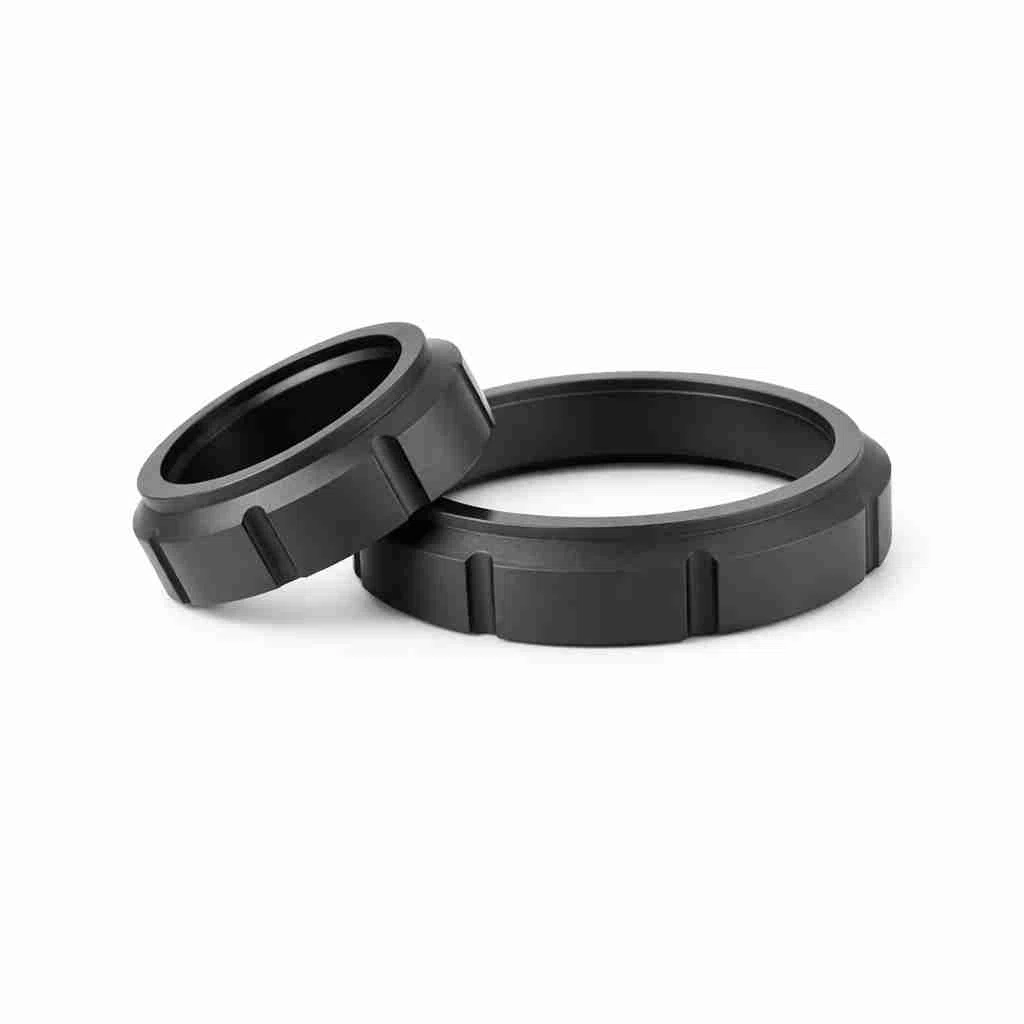
Custom Carbon Graphite Components
- • Non-standard dimensions
- • Custom grooves and drive notches
- • Anti-rotation features and ports
- • Stepped profiles & special geometry
- • Customer-specific inspection
Can’t Find the Seal Ring You Need?
Upload a Drawing or Product PhotoWhat Does a Carbon Seal Ring Manufacturer Do?
A carbon seal ring manufacturer produces rigid machined carbon graphite components used to control leakage between stationary and rotating equipment parts. Manufacturing the ring is different from designing the entire mechanical seal assembly.
The manufacturer’s role includes:
- Reviewing the sealing application
- Evaluating the medium
- Selecting a material direction
- Confirming dimensions
- Machining ring geometry
- Producing grooves and features
- Finishing or lapping the sealing face
- Inspecting critical characteristics

What Is a Carbon Seal Ring?
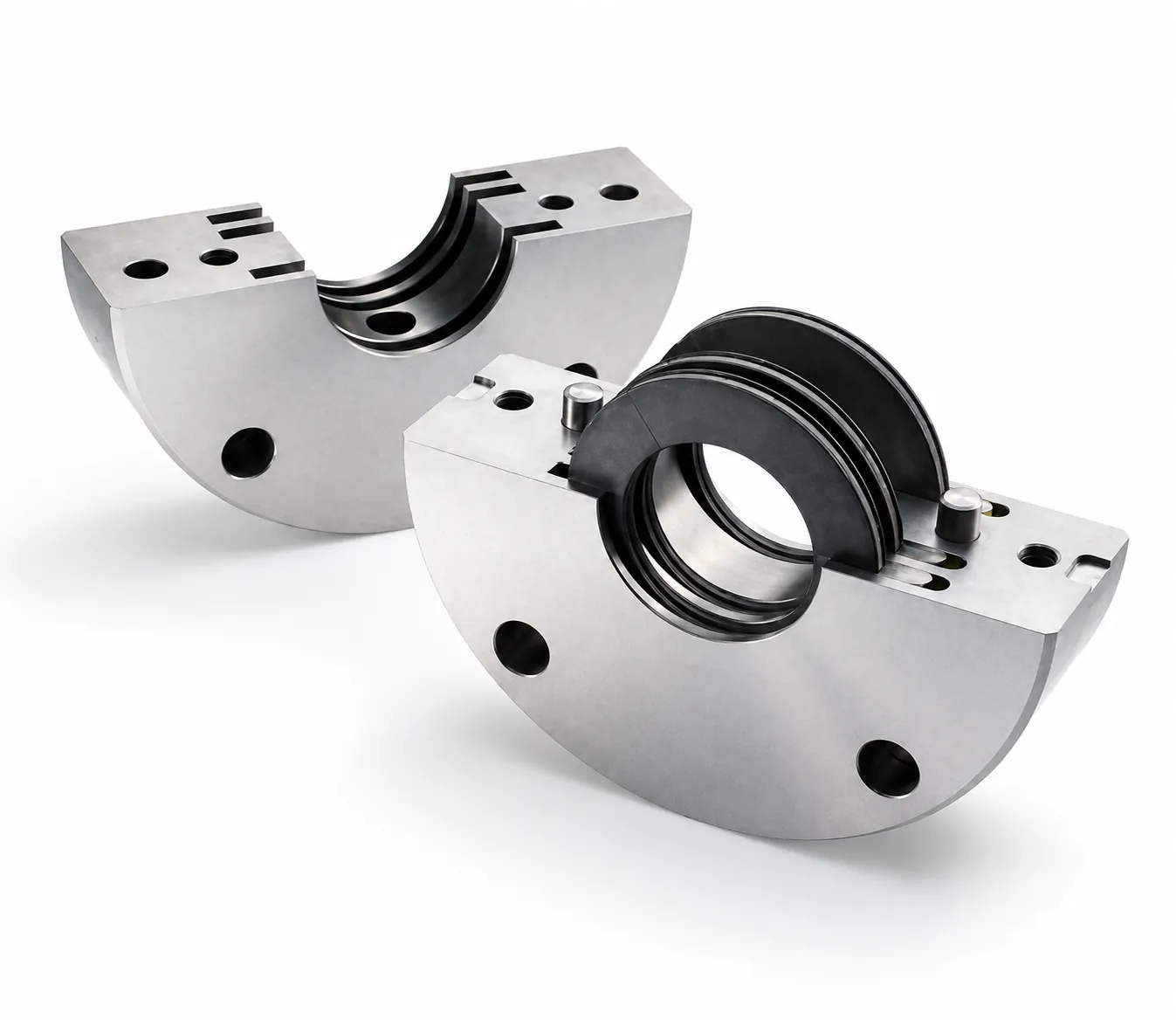
A carbon seal ring is a precision-machined rigid carbon graphite component used in a mechanical or dynamic sealing system to control the passage of liquids, gases, vapors, or contaminants around a rotating or reciprocating part.
The ring may operate as:
- A mechanical seal face
- A segmented circumferential seal
- A floating ring (subject to verified requirement)
- Another application-specific sealing component
Carbon graphite may be selected because suitable grades can offer:
Note: These properties depend on the exact material grade and operating conditions.
How Does a Carbon Seal Ring Work?
Seal designs vary significantly. The working principle depends on the specific geometry and sealing system.
Mechanical Face Seal Operation
- One face normally rotates with the shaft while the mating face remains stationary, depending on the seal design.
- A spring or another loading mechanism maintains controlled face contact.
- A thin fluid film may form between the faces.
- The faces control leakage while managing friction and heat.
- The carbon graphite face gradually wears according to the application.
Segmented Ring Operation
- Several matched carbon segments surround a shaft.
- Springs or another retaining method maintain the ring assembly.
- Controlled clearance limits gas, vapor, or steam leakage.
- Segment joints accommodate assembly and thermal movement.
- The ring operates according to the shaft, housing, temperature, and pressure conditions.
Performance Factors
Performance may be affected by multiple variables, including:

Carbon Seal Ring Types Available From CARBOLVE
By Seal Function
- • Mechanical face seal ring
- • Segmented shaft seal ring
- • Replacement seal ring
- • Custom graphite sealing component
- [Confirm CARBOLVE product capability for floating/labyrinth/gland rings]
By Construction
- • Solid one-piece ring
- • Split ring
- • Multi-segment ring
- • Ring with groove / notch
- • Ring with anti-rotation feature
- • Ring with ports or channels
By Project Type
- • OEM seal ring
- • Replacement seal ring
- • Prototype seal ring
- • Obsolete part reproduction
- • Maintenance spare
- • Repeat-order production
By Processing Stage
- • Carbon graphite blank
- • Rough-machined ring
- • Finish-machined ring
- • Ground ring
- • Lapped seal face
- • Polished ring
Carbon Seal Ring Geometry and Critical Features
Geometry affects fit, loading, leakage control, heat generation, movement, and durability. CARBOLVE manufactures features according to verified technical drawings.

Sealing Face
May require machining, grinding, lapping, or another controlled finish according to the application.
Inside & Outside Diameters
Diameter affects shaft, housing, and assembly fit.
Axial Thickness & Face Width
Influence strength, assembly, heat transfer, and contact area.
Grooves & Channels
Hydrodynamic, cooling, lubrication, or flow features must follow an approved design.
Segment Joints
Configurations may include butt, overlap, step, or interlocking joints where verified.
Spring Groove
Segmented rings may include a groove for a retaining or garter spring.
Carbon Graphite Materials for Seal Rings
No single material grade is suitable for every sealing application. Selection depends on the sealed medium, temperature, pressure, speed, mating material, chemical exposure, and required friction.
Carbon Graphite
May provide an application-specific balance of friction, strength, thermal behavior, wear, and chemical resistance.
Electrographite
May be considered for selected high-temperature or demanding mechanical applications, subject to verified grade properties.
Resin-Bonded Graphite
May offer application-specific mechanical and dimensional properties.
Impregnated Carbon
Impregnation may reduce permeability or modify mechanical, thermal, and chemical behavior.
| Material Property | Why It Matters | CARBOLVE Data |
|---|---|---|
| Density | Supports material identification and consistency review | Available by verified grade |
| Hardness | Relates to machining and wear behavior | Available by verified grade |
| Flexural strength | Relevant to ring handling and loading | Available by verified grade |
| Compressive strength | Relevant to face and assembly loading | Available by verified grade |
| Porosity | Influences permeability and impregnation requirements | Available by verified grade |
| Friction behavior | Influences heat and wear | Application dependent |
| Thermal conductivity | Influences heat dissipation | Available by verified grade |
| Thermal expansion | Influences clearance and dimensional stability | Available by verified grade |
| Chemical resistance | Must suit the sealed medium | Application dependent |
| Maximum temperature | Depends on atmosphere and grade | Available by verified grade |
| Pressure-velocity capability | Depends on seal design and material | Application dependent |
Why Are Some Carbon Seal Rings Impregnated?
Carbon graphite may be impregnated to modify permeability, strength, wear behavior, chemical resistance, thermal behavior, and leakage performance.
| Impregnation Direction | Possible Purpose | Required Application Data |
|---|---|---|
| Resin impregnation | Reduce permeability or modify mechanical behavior | Medium, temperature and pressure |
| Metal impregnation | Modify strength, conductivity or wear behavior | Speed, temperature and mating face |
| Non-impregnated grade | Suitable for selected dry or high-temperature conditions | Atmosphere, load and leakage requirement |
| Custom treatment | Application-specific performance direction | Complete technical review |
Impregnation must not be selected from the name alone. Compatibility with the medium, temperature, pressure, counterface, and seal design must be confirmed.

Custom Carbon Seal Ring Specifications
CARBOLVE manufactures seal rings according to approved drawings and verified manufacturing capabilities.
| Dimensional Parameters | |
|---|---|
| Outside diameter | Produced according to drawing, sample, or confirmed housing data |
| Inside diameter | Produced according to shaft or assembly requirements |
| Axial thickness | Confirmed according to the approved drawing |
| Radial face width | Application and design dependent |
| Sealing-face geometry | Flat, stepped, grooved, or custom where verified |
| Chamfer and radius | Produced according to drawing or approved sample |
| Drive notch or lug | Available according to verified machining capability |
| Anti-rotation feature | Available according to confirmed design |
| Ports or flow channels | Available according to drawing and feasibility review |
| Segment quantity | Confirmed according to ring design |
| Joint geometry | Butt, overlap, step, or custom where verified |
| Spring groove | Produced according to approved segmented-ring design |
Geometric Requirements
The following features are confirmed according to the approved drawing and CARBOLVE’s verified manufacturing capability:
- Flatness
- Parallelism
- Perpendicularity
- Concentricity
- Roundness
- Runout
- Surface finish
- Lapped-face requirement
- Matching requirement
- Segment-joint fit
Operating Information Required for Seal Selection
Not every field is required for every seal-ring type. Provide all information currently available for accurate evaluation.
| Information | Buyer Should Provide |
|---|---|
| Equipment | Pump, compressor, mixer, turbine, rotary joint, or other equipment |
| Equipment model | Manufacturer, model and nameplate photograph |
| Ring function | Face seal, segmented shaft seal, floating ring, or other |
| Sealed medium | Liquid, gas, vapor, steam, chemical, slurry or other |
| Temperature | Normal, minimum and maximum operating temperature |
| Pressure | Suction, discharge, chamber or differential pressure |
| Shaft speed | Rated and actual operating speed |
| Counterface | Silicon carbide, tungsten carbide, ceramic, metal or other |
| Operating mode | Dry, lubricated, flooded, intermittent or continuous |
| Existing failure | Leakage, wear, cracking, chipping, heat or distortion |
Common Carbon Seal Ring Problems
Replacing the carbon ring alone will not always stop leakage. CARBOLVE evaluates the existing ring, failure pattern, and operating conditions before recommending a replacement direction.
Excessive Leakage
Factors: Worn sealing face, poor flatness, incorrect surface finish, improper material, shaft misalignment.
CARBOLVE Response: Review the existing ring, mating face, drawing, equipment, medium, and failure pattern.
Rapid Face Wear
Factors: Unsuitable material, incorrect counterface, abrasive medium, poor lubrication, excessive pressure.
CARBOLVE Response: Evaluate the ring material, counterface, medium, pressure, speed, temperature, and lubrication.
Thermal Cracking
Factors: Rapid temperature changes, poor heat dissipation, dry running, incorrect material, uneven loading.
CARBOLVE Response: Review the thermal cycle, cooling, material grade, ring geometry, and assembly conditions.
Edge Chipping
Factors: Impact during handling, thin geometry, incorrect installation, excessive clamping force, vibration.
CARBOLVE Response: Review packaging, handling, chamfers, ring geometry, assembly method, and operating load.
Segmented Ring Leakage
Factors: Incorrect joint geometry, worn segment ends, incorrect shaft clearance, weak spring, shaft damage.
CARBOLVE Response: Review all segments as a matched set, including joints, markings, spring, and shaft size.
Replacement Does Not Fit
Factors: Wrong equipment model, worn sample, missing groove details, incorrect measurement method.
CARBOLVE Response: Use the drawing, equipment model, original part number, and clear photographs for confirmation.
Why Work With CARBOLVE as Your Carbon Seal Ring Manufacturer?
Focused Carbon Experience
CARBOLVE focuses on carbon and graphite components for electrical, vacuum, sealing, wear, and mechanical applications.
Mechanical & Segmented Rings
CARBOLVE can evaluate both solid seal-face and segmented-ring requirements according to verified capability.
Drawing & Sample Production
Products can be evaluated from drawings, samples, photographs, dimensions, equipment models, and part numbers.
Custom Geometry Support
Diameters, thickness, grooves, notches, ports, chamfers, radii, and segment joints can be reviewed according to the design.
Application-Based Material Review
Material discussions consider medium, temperature, pressure, speed, mating face, and required leakage control.
Inspection & Confirmation
Critical dimensions, face condition, geometry, identification, matched sets, and packaging can be confirmed before shipment.
Custom Carbon Seal Ring Manufacturer for OEM and Replacement Projects
CARBOLVE can evaluate new OEM seal-ring designs, replacement mechanical seal faces, segmented shaft-sealing rings, obsolete parts, drawing-based components, and sample reproductions. Final material, design, tolerance, surface requirements, feasibility, and pricing must be confirmed after technical review.

How CARBOLVE Handles a Custom Seal Ring Inquiry
Submit Info
Provide drawing, sample, photos, equipment model, dimensions, and quantity.
Application Review
Review seal function, medium, temperature, pressure, speed, and counterface.
Geometry Confirm
Confirm OD, ID, thickness, grooves, notches, ports, and segment joints.
Material Direction
Evaluate existing material or suggest a carbon graphite family based on data.
Surface Confirm
Confirm machined, ground, lapped, or polished requirements.
Quotation
Confirm material, tolerances, quantity, inspection, and commercial terms.
Sample Validation
Customer evaluates fit, contact, leakage behavior, and equipment operation.
Batch Production
Proceed with production after the relevant specification or sample is approved.
How Carbon Seal Rings Are Manufactured
- Material Selection: Select a confirmed carbon or graphite material according to requirements.
- Blank Cutting: Prepare carbon graphite material to a preliminary size.
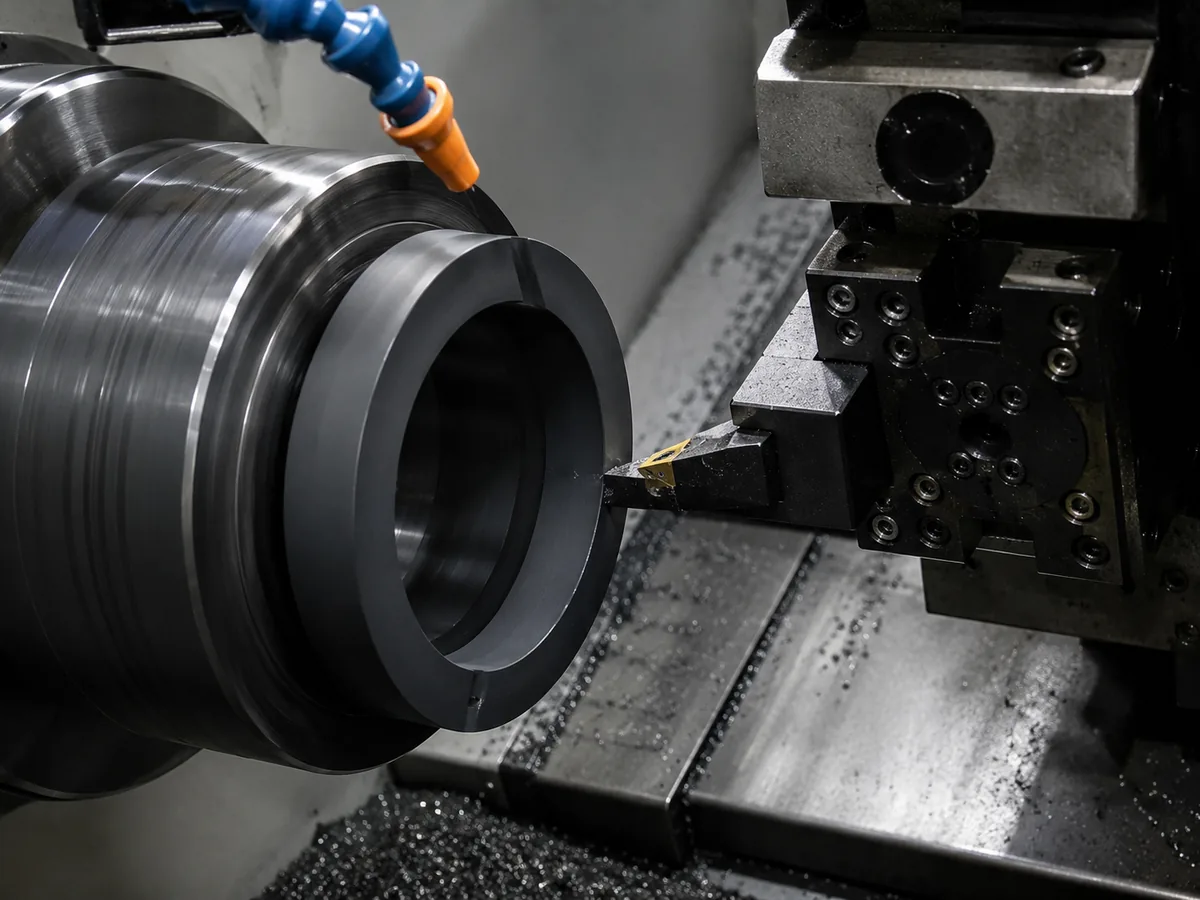
- Precision Machining: Machine ID, OD, thickness, steps, grooves, slots, and notches.
- Grinding: Improve dimensions, flatness, parallelism, or surface preparation.
- Segmentation (Where verified): Cut and match individual ring sections, prepare joints.
- Lapping/Polishing: Finish the seal face according to verified capability.
- Inspection & Packing: Dimensional checks, segment matching, and protective packaging.
Note: Processes like graphitization or resin impregnation are only included when verified by CARBOLVE.
Seal-Face Lapping and Surface Requirements
The sealing face often requires controlled flatness and surface condition to support stable contact and leakage control.
| Surface Requirement | Purpose | Verification Required |
|---|---|---|
| Machined finish | General geometry and non-critical surfaces | Drawing requirement |
| Ground finish | Improved dimensional and surface control | Equipment capability |
| Lapped face | Controlled face contact and flatness | Verified lapping capability |
| Polished surface | Application-specific finish | Approved specification |
Carbon Seal Ring Quality Control Before Shipment
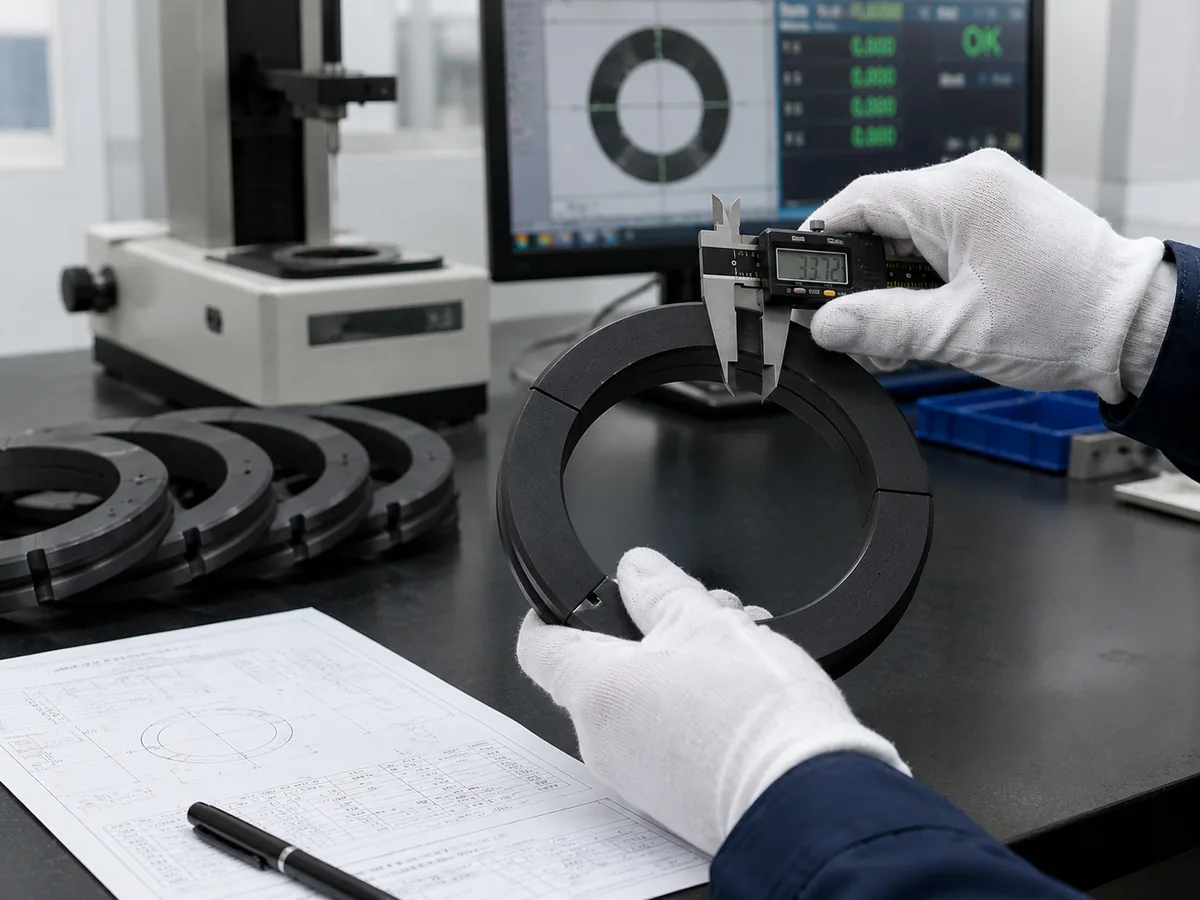
- Material Identification: Confirm the agreed material or grade reference.
- Dimensional Inspection: Check OD, ID, thickness, face width, grooves, notches, and segment geometry.
- Geometric Inspection: Check flatness, parallelism, perpendicularity, and segment-joint fit where required.
- Surface Inspection: Check for cracks, chips, scratches, edge damage, and lapping damage.
- Segment Matching: For segmented rings, check joint matching, ring identification, and set completeness.
- Sample Comparison: Compare critical features against the approved reference when producing from a sample.
Carbon Seal Ring Applications

Industrial Pumps
Typical products include mechanical face seal rings, stationary carbon faces, and rotating replacement components.

Compressors
Typical products include segmented carbon rings, mechanical seal faces, and custom shaft-sealing components.

Mixers and Agitators
Typical products include mechanical seal faces and carbon sealing rings for contamination control.

Turbines & Power Gen
Typical products include segmented carbon rings and custom carbon graphite components where verified.

Chemical Processing
Carbon graphite may be considered for selected chemical environments after a thorough compatibility review.

Water Treatment
Typical products include pump seal faces and replacement carbon rings for wastewater equipment.
How to Choose the Right Carbon Seal Ring
How to Measure a Carbon Seal Ring for Replacement
- Outside Diameter: Measure the largest external diameter at several positions.
- Inside Diameter: Measure the bore or shaft-related internal dimension.
- Axial Thickness: Measure the complete ring thickness at several points.
- Face Width: Record the radial width of the sealing surface.
- Grooves & Steps: Record width, depth, diameter, and position.
- Notches & Ports: Measure width, depth, angle, orientation, and location.
- Segmented Rings: Record number of segments, joint type, spring groove, and assembled diameter.
Material and Design Comparisons
Carbon Seal Ring vs Graphite Seal Ring
"Carbon seal ring" is a broad commercial term. "Graphite seal ring" usually describes a part from graphite-rich material. Carbon graphite, electrographite, and impregnated carbon are distinct engineered families. Material terminology alone is not enough for selection.
Mechanical Face vs Segmented Ring
A mechanical face seal provides axial face contact (common in pumps/mixers) and requires flat faces. A segmented carbon ring provides circumferential shaft sealing (common in turbines/compressors) and requires controlled shaft clearance and joint fit.
Carbon Graphite vs Silicon Carbide
These are commonly considered as mating seal-face materials rather than direct universal substitutes. A common arrangement uses carbon graphite against a harder SiC mating face, selected according to medium, speed, and lubrication.
OEM vs Replacement Projects
OEM projects rely on engineering drawings, prototype testing, and planned demand. Replacement projects rely on existing models, worn samples, and reverse measurement. A replacement component should not be called identical unless materials and tolerances are verified.
Carbon Seal Ring Troubleshooting Guide
Replacing the carbon ring alone may not correct the underlying problem. The entire sealing system must be considered.
| Symptom | Possible Contributing Factors | Information to Check |
|---|---|---|
| Excessive leakage | Face wear, flatness, loading, alignment, medium or installation | Seal faces, equipment, pressure and leakage pattern |
| Rapid wear | Material, abrasive medium, speed, pressure or poor lubrication | Grade, counterface, operating conditions and wear pattern |
| Cracking | Thermal shock, stress, dry running, assembly load or impact | Temperature cycle, installation and crack location |
| Chipping | Handling, sharp edges, vibration or incorrect fit | Packaging, chamfers, housing and installation |
| Overheating | Friction, poor cooling, dry running, pressure or misalignment | Temperature, cooling, load and face condition |
| Segmented-ring leakage | Joint wear, clearance, spring, shaft condition or wrong assembly | Segments, joints, shaft and spring |
| Ring sticking | Deposits, clearance, corrosion, distortion or temperature | Ring movement, housing and medium |
Important Note: Carbon seal-ring symptoms can also result from the mating face, shaft, housing, bearings, springs, elastomers, alignment, cooling system, process medium, installation, or the complete mechanical seal assembly.
How to Choose a Carbon Seal Ring Manufacturer
- Product Knowledge: Can they explain the difference between mechanical face rings and segmented rings?
- Material Knowledge: Do they consider medium, temperature, pressure, and mating material before recommending a grade?
- Precision Machining: Can they control thickness, grooves, notches, ports, and segment joints?
- Face-Finishing: Can they explain their verified grinding, lapping, and flatness inspection capability?
- Technical Communication: Do they request complete application info rather than guessing?
Evaluate CARBOLVE
We provide verified evidence of our manufacturing capabilities.
Manufacturing
- • Workshop photos
- • Machining photos
- • Lapping photos
Inspection
- • Dimensional checks
- • Material reports
- • Inspection reports
Product
- • Product packaging
- • Shipment photos
- • Product catalog
Custom Carbon Seal Ring Solutions
Sample Application Formats
Case 1: Mechanical Face Seal Ring
- Equipment: [Insert verified data]
- Medium: [Insert verified data]
- Problem: [Insert verified data]
- Solution: [Insert verified data]
- Result: The seal face met the agreed dimensional and surface requirements.
Case 2: Segmented Carbon Seal Ring
- Equipment Type: [Insert verified data]
- Shaft Diameter: [Insert verified data]
- Problem: [Insert verified data]
- Solution: [Insert verified data]
- Result: The segmented ring assembled correctly around the shaft during validation.
Case 3: Obsolete Replacement Ring
- Model: [Insert verified data]
- Challenge: Missing drawing information
- Solution: [Insert verified data]
- Result: The replacement ring achieved the required assembly fit during customer testing.
Frequently Asked Questions
What does a carbon seal ring manufacturer produce?
Is a carbon seal ring the same as a mechanical seal?
Does replacing the carbon ring always stop leakage?
How long does a carbon seal ring last?
Can CARBOLVE manufacture a seal ring from a drawing?
Need a Carbon Seal Ring Manufacturer for Your Project?
Send your seal-ring type, equipment model, original part number, product drawing, physical sample, clear photographs, ring dimensions, existing material, sealed medium, temperature, pressure, shaft speed, counterface, and required quantity. Complete information helps CARBOLVE evaluate feasibility and quotation details.
What Information Is Needed for a Carbon Seal Ring Quote?
Not every item is required for every inquiry. Provide all information currently available.
- • Product name & Seal-ring type
- • Equipment manufacturer & model
- • Original part number
- • Existing ring photographs
- • Physical sample availability
- • Dimensions (OD, ID, Thickness)
- • Grooves, notches, segment quantity
- • Existing material or grade
- • Counterface material
- • Sealed medium, Temp, Pressure
- • Shaft speed & operating mode
- • Trial/Order quantity & Annual demand