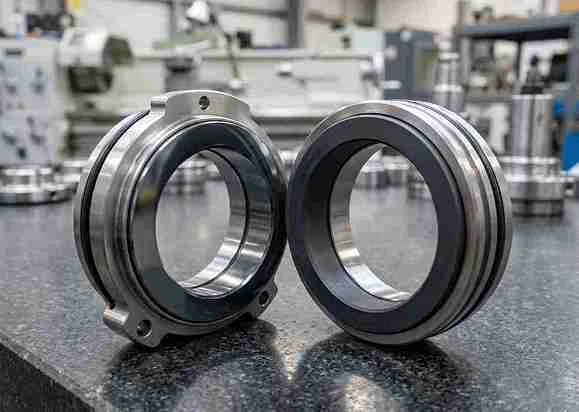
Replacement Carbon Seal RingsManufacturer
CARBOLVE evaluates and manufactures replacement carbon seal rings based on equipment models, OEM part numbers, engineering drawings, physical samples, and operating data. We support projects ranging from segmented carbon seal rings and mechanical seal faces to replacement turbine and compressor rings.
Carbon seal ring type, material and functional geometry must be verified before replacement; matching dimensions alone do not confirm compatibility.
- Equipment & Part Number Review
- Drawing & Sample-Based Replacement
- Carbon & Graphite Material Verification
- Obsolete Seal Ring Support
- Precision Machining & Inspection
Send the equipment manufacturer/model, seal type, OEM number, ring photos, dimensions, carbon grade if known, mating component, operating conditions and required quantity.
Send Your Old Carbon Ring on WhatsApp
Find the Right Replacement Carbon Seal Ring
Select your ring type and identification method to begin.
1 What type of carbon ring do you have?
2 How would you like to identify it?
Warning: Dimensions alone do not establish material or functional compatibility.
Which Replacement Carbon Seal Rings Does CARBOLVE Manufacture?
This page focuses on replacement carbon and carbon-graphite seal ring components used in industrial pumps, turbines, compressors, blowers, mechanical seals, and other verified rotating-equipment sealing systems.
Industrial Carbon Components
- Segmented carbon ring sets
- Carbon packing rings
- Carbon graphite mechanical seal faces
- Solid carbon seal rings
- Replacement carbon inserts
- Custom carbon sealing components
Products Requiring Separate Confirmation
CARBOLVE’s core scope is precision carbon and graphite sealing components rather than complete seal assemblies unless specifically verified. We do NOT target consumer repair kits.
- • Complete mechanical seals
- • Complete carbon ring gland assemblies
- • Seal housings & Metal carriers
- • Springs (Garter/Compression)
- • SiC / TC / ceramic mating rings
- • Personal-watercraft carbon seal kits
Replacement Carbon Seal Rings by Product Type

Replacement Segmented Carbon Seal Rings
For verified turbine, compressor, blower and other circumferential sealing systems.
Learn about Segmented Rings →
Replacement Carbon Mechanical Seal Faces
Axial/end-face sealing components for mechanical seal applications.
Learn about Seal Faces →
Replacement Turbine Carbon Packing Rings
For verified steam and industrial turbine applications.

Replacement Compressor Carbon Rings
For verified compressor shaft seal applications.
What Are Replacement Carbon Seal Rings?
Replacement carbon seal rings are carbon or carbon-graphite sealing components manufactured or selected to replace worn, broken, obsolete, discontinued, or unavailable rings in existing industrial sealing systems. A correct replacement should reproduce the required material, functional geometry, dimensions, mating relationship, and equipment-specific sealing requirements.
"Carbon seal ring" is a broad term, so the ring type should be identified before a replacement specification is created.
Replacement Workflow
Is Your Carbon Ring Segmented or a Mechanical Seal Face?
Do not use one specification checklist for both product types.
| Factor | Segmented Carbon Ring | Mechanical Seal Face |
|---|---|---|
| Construction | Multiple segments | Usually continuous ring |
| Main sealing direction | Circumferential / radial | Axial / end-face |
| Runs relative to | Shaft / rotor | Opposing seal face |
| Joint | Butt / overlap / etc. | Normally no segment joint |
| Spring groove | May exist (for garter spring) | Different seal loading system |
| Key parameters | Shaft clearance, joints, segments | Flatness, face width, mating material |
How Do Industrial Carbon Seal Rings Work?

Circumferential / Segmented Ring
Carbon segments surround the shaft. Depending on design, contact, intermittent contact, or controlled clearance may be used.
Leakage is controlled around the shaft circumference.

Mechanical Seal Face
Carbon face operates against a mating face. A thin fluid film normally exists between operating faces according to seal design.
Leakage is controlled across the axial/end-face interface.
The operating mechanism must be identified before replacement dimensions and material are approved.
Best Information for Identifying a Replacement Carbon Seal Ring
The best replacement evaluation normally combines several sources. Here is the hierarchy of technical information value:
- Current engineering drawing
- Verified OEM or equipment specification
- Equipment manufacturer and model
- OEM / existing part number
- Original material grade/data
- New or unused physical sample
- Complete used ring set
- Worn sample
- Broken components
- Complete dimensions
- Photographs
- Operating conditions
Methods to Identify Your Replacement Ring
By Equipment Model
Request: Equipment manufacturer, model, serial number, type, seal location, nameplate, or service manual.
By OEM Part Number
Part numbers are valuable references, but the final replacement should be verified against available product and equipment information.
From a Drawing
A controlled drawing defines material, dimensions, tolerances, ring type, joints, and features. Operating conditions are still requested.
From a Physical Sample
A sample shows ring construction, dimensions, segments, joints, and wear, but may not reveal the complete original engineering specification.
From Photos
Photos support initial ID, but normally cannot confirm exact carbon grade, original unworn dimensions, tolerances, or shaft clearance.
Send Photos on WhatsApp →By Dimensions
Identical OD × ID × width does not prove two carbon seal rings are interchangeable. Dimensions must be combined with application data.
Replacement Carbon Seal Ring Specifications
Replacement Segmented Carbon Ring Parameters
| Material | Original / proposed grade |
| Assembled ID | Drawing/sample |
| OD & Axial Width | Drawing/sample |
| Segment Count | Original design |
| Joint Type | Butt / overlap / other |
| Shaft Diameter & Material | Equipment data |
| Running Clearance | Approved design |
| Temp / Pressure / RPM | Operating condition |
Replacement Carbon Mechanical Seal Face Parameters
| Carbon Grade | Existing / proposed |
| Rotary / Stationary | Seal design |
| OD / ID / Thickness | Drawing/sample |
| Seal Face Width | Approved design |
| Flatness & Finish | Approved requirement |
| Mating Material | SiC / TC / ceramic / other |
| Process Fluid | Operating condition |
| Temp / Pressure / RPM | Operating condition |
Replacement Carbon Seal Ring Materials
A material family name is not sufficient to establish an exact replacement grade. Material substitution should be treated as an engineering change.
Carbon Graphite
Broad mechanical-carbon material family for general sealing.
Electrographite
Used in selected sealing applications requiring specific thermal/friction properties.
Resin-Impregnated Carbon
Application-specific direction to reduce permeability and increase strength.
Metal/Antimony-Impregnated
Application specific for higher pressure/temperature conditions.
What Determines Material Selection?
Evaluating Physical Carbon Ring Samples
New / Unused Sample
- Basic geometry: Strong reference
- Original dimensions: Strong reference
- Working surface: Original
- Face flatness: Stronger reference
- Failure info: Limited
Worn Sample
- Basic geometry: Usually visible
- Original dimensions: May be altered
- Working surface: Shows wear
- Face flatness: Usually no longer original
- Failure info: Useful
What a Worn Ring May Not Reveal
A worn segmented carbon ring or mechanical seal face is useful for identification but is not necessarily a complete original specification. Original shaft clearance, joint gap, lapped flatness, exact material grade, and original tolerances may be lost to wear. Missing functional geometry should not be reconstructed by guesswork.
OEM vs Aftermarket Carbon Seal Rings
An OEM Component is produced or specified by the original equipment/seal manufacturer. An Aftermarket Replacement is produced by another manufacturer according to an independently verified replacement specification.
CARBOLVE evaluates aftermarket replacements by comparing material, drawing geometry, and operating conditions, rather than assuming universal compatibility.
Replacement vs Custom Carbon Seals
A Replacement begins with an existing component or machine. A Custom project establishes or modifies a specification.
A replacement project becomes a custom engineering project when material changes, clearance changes, joint design changes, or machine operating conditions change.
Common Replacement Carbon Seal Ring Challenges
OEM Ring Is Discontinued
CARBOLVE reviews equipment, drawings, samples, and operating data to support obsolete replacement.
Only a Worn Ring Exists
We help identify what wear has changed and recover functional geometry.
Replacement Fits but Leaks
We check functional geometry, material, shaft condition, and operating conditions, not just dimensions.
Finished Ring Manufacturing & Quality Control
How CARBOLVE Manufactures Finished Replacement Carbon Seal Rings
Precision Machining
A replacement ring should be inspected against a controlled specification rather than a generic tolerance. We perform precision turning, segment cutting, joint machining (butt/overlap), and feature machining.
Seal-Face Finishing
For mechanical seal face rings, required surface finish and flatness are achieved according to verified capability.
Type-Specific Inspection
Segmented rings are checked for segment matching, joint fit, and assembled dimensions. Face rings are inspected for flatness and face width.

Verified Industrial Applications
Steam Turbines
Focusing on segmented carbon packing rings. Request turbine model, OEM part number, shaft diameter, segment count, steam pressure/temp, and RPM.
Compressors & Blowers
Segmented shaft rings or floating/gap rings where verified. Identify machine model, gas, pressure, temperature, and existing ring design.
Pumps & Mechanical Seals
Carbon mechanical seal faces or inserts. Request seal model, rotary/stationary position, face dimensions, mating material, fluid, and pressure.
Common Mistakes When Ordering Replacement Carbon Seal Rings
Frequently Asked Questions
Are dimensions alone enough to identify a replacement?
Can two carbon seal rings with identical dimensions be different?
Can CARBOLVE reproduce a worn carbon seal ring?
Can CARBOLVE reproduce broken carbon ring segments?
Can carbon seal material be identified by color?
Can a different carbon grade replace the original?
Is there a universal carbon ring clearance?
Does replacing a carbon ring always stop leakage?
Are industrial carbon seal rings the same as personal-watercraft carbon seal kits?
Identify or Request Replacement Carbon Seal Rings
Send all information currently available and CARBOLVE can identify additional information required for review.