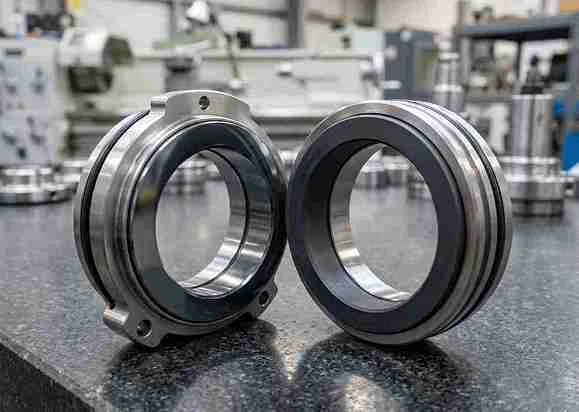
Custom Carbon Seals for Industrial Equipment
CARBOLVE manufactures custom carbon and carbon-graphite sealing components from engineering drawings, physical samples, dimensions, and existing seal specifications. Final material, geometry, and functional sealing requirements should be confirmed according to the actual seal design, mating component, and operating conditions.
- Drawing & Sample-Based Manufacturing
- Application-Based Technical Review & Material Selection
- OEM, Prototype & Obsolete-Part Support
Send your seal type, drawing or sample, existing material, dimensions, shaft or mating-face information, process media, temperature, pressure, speed, and quantity.

Precision Machined
To Verified Specifications
How Would You Like to Start Your Custom Carbon Seal Project?
Select the information you currently have to begin the engineering review.
STEP 1: What type of carbon seal component?
STEP 2: What information do you have?
I Have a Drawing
Upload your CAD or PDF drawing for manufacturing review.
I Have a Physical Sample
Send a new, worn, or broken component for evaluation.
I Have Only Dimensions
Provide OD, ID, width, and functional geometry.
I Need an OEM Component
Developing new rotating equipment requiring a carbon seal.
Custom Carbon Components vs. Complete Seal Assemblies
This page focuses on custom carbon and carbon-graphite sealing components for industrial rotating equipment. CARBOLVE should be presented as the manufacturer of the verified carbon/graphite component unless complete seal-system supply has been confirmed.
CARBOLVE Core Product Scope
- Carbon mechanical seal faces
- Carbon graphite seal rings
- Segmented carbon ring sets
- Carbon packing rings & inserts
- Precision-machined carbon sealing components
System Components Requiring Verification
- Complete mechanical/cartridge seals
- Circumferential seal metal housings & glands
- Metal carriers, springs, & bellows
- Elastomers & O-rings
- SiC, Tungsten Carbide, or Ceramic mating faces
What Are Custom Carbon Seals?
Custom carbon seals are carbon or carbon-graphite sealing components manufactured to an approved application-specific specification rather than selected only from a standard catalog size or existing part number.
Depending on the seal design, customization may involve material, OD, ID, thickness, sealing surfaces, segmentation, joints, grooves, holes, mounting features, or other functional geometry. The correct specification should connect:

How Do Carbon Sealing Components Work?
Axial End-Face Sealing
Mechanical seal face architecture. The carbon face operates relative to an opposing mating face (e.g., SiC, TC) along the shaft axis.
Circumferential Shaft Sealing
Segmented carbon ring surrounds a shaft or rotor, providing radial sealing. Joint geometry and running clearance are critical.
Other Ring Designs
May use clearance, contact, floating, or labyrinth-like geometry depending on the verified seal design and equipment requirements.
The sealing principle must be identified before the material and functional geometry are finalized.
What Can Be Customized on a Carbon Seal?
Customization feasibility depends on carbon material, component size, geometry, machining method, tolerance, sealing function, mating component, and operating conditions.
Dimensions & Profile
OD, ID, Axial Width/Thickness, Face Width (for mechanical faces), Chamfers, Radii, and custom profiles according to drawing.
Machined Features
Spring grooves, O-ring grooves, through-holes, ports, drive slots, anti-rotation features, and steps/recesses where technically required.
Carbon Material
Selection from verified CARBOLVE carbon graphite, electrographite, or impregnated grades based on application review.

Segment & Joint Geometry
For segmented rings: Segment count, butt joints, overlap joints, and established running clearances.
Surface Requirements
Seal-face flatness (for mechanical seal faces according to verified capability) and specific surface finish requirements.
Identification & Packaging
Part marking and specialized packaging to protect functional sealing surfaces during transit.
Custom Carbon Seal Specification Framework
Information required to establish a controlled CARBOLVE manufacturing specification.
Mechanical Seal Face Parameters
| Parameter | Information Source |
|---|---|
| Carbon Material / Impregnation | Approved grade |
| Rotary / Stationary Design | Seal design |
| OD / ID / Thickness | Drawing |
| Working Face Width / Step | Seal design / Drawing |
| Grooves / Holes / Slots | Drawing |
| Flatness & Surface Finish | Approved requirement |
| Mating Material | Seal-system data |
| Fluid / Temp / Press / RPM | Application data |
Segmented Carbon Ring Parameters
| Parameter | Information Source |
|---|---|
| Carbon Material | Approved grade |
| Assembled ID / OD / Width | Drawing |
| Segment Count & Joint Type | Seal design (Butt/Overlap) |
| Spring Groove / Anti-Rotation | Where applicable |
| Shaft Diameter & Material | Equipment data |
| Running Clearance | Approved design |
| Ring Stages | Seal-system design |
| Media / Temp / Press / RPM | Application data |
Carbon Materials for Custom Seals
Carbon seal material should be selected according to the complete sealing application rather than the component dimensions alone. Existing material codes can be used as technical references, but final selection depends on available grade data.
Carbon Graphite vs. Electrographite
Carbon graphite is a broad mechanical-carbon family often offering self-lubricating behavior. Electrographite represents a different structural family used in selected tribological applications. Selection is grade and application dependent.
Resin vs. Metal-Impregnated Carbon
Impregnation (resin, antimony, or other metals) can modify permeability, mechanical strength, thermal behavior, and chemical compatibility. Results depend on the base carbon, impregnant, and operating limits.
Material Selection Matrix Requirements
- Seal Function: Mechanical face, segmented ring, etc.
- Mating Component: SiC, TC, Ceramic, Metal shaft/sleeve
- Process Media: Liquid, gas, steam, chemical, abrasive
- Temperature: Normal, max, thermal cycling
- Pressure & Speed: Differential, RPM, surface speed
- Lubrication: Wet, low-lubricity, intermittent dry
Note: Carbon seal material cannot be reliably identified from appearance, color, or weight by hand alone. Documentation is preferred.
Custom Carbon Seal Development Projects
How CARBOLVE approaches different engineering starting points.
Drawing-Based Production
We review dimensions, tolerances, functional surfaces, joints, mating components, and operating conditions against manufacturing feasibility. Production follows the approved specification.
Sample-Based Development
A worn carbon seal is a useful engineering reference, but it is not automatically a complete manufacturing specification. We separate original design intent from wear patterns to propose a new specification.
New OEM Development
For new pumps, compressors, or turbines. Requires shaft/mating geometry, proposed seal type, operating conditions, and prototype validation.
Obsolete Seal Recovery
Obsolete does not automatically mean reproducible. Sufficient engineering information and suitable material must first be confirmed via fragments or OEM data.
Engineering Changes
Modifying geometry (joints, clearances, grooves) or changing carbon material due to new operating conditions or existing failure modes.
Dimensions-Only Project?
Dimensions can start a review, but matching dimensions do not establish sealing-function or material compatibility. Application data is required.
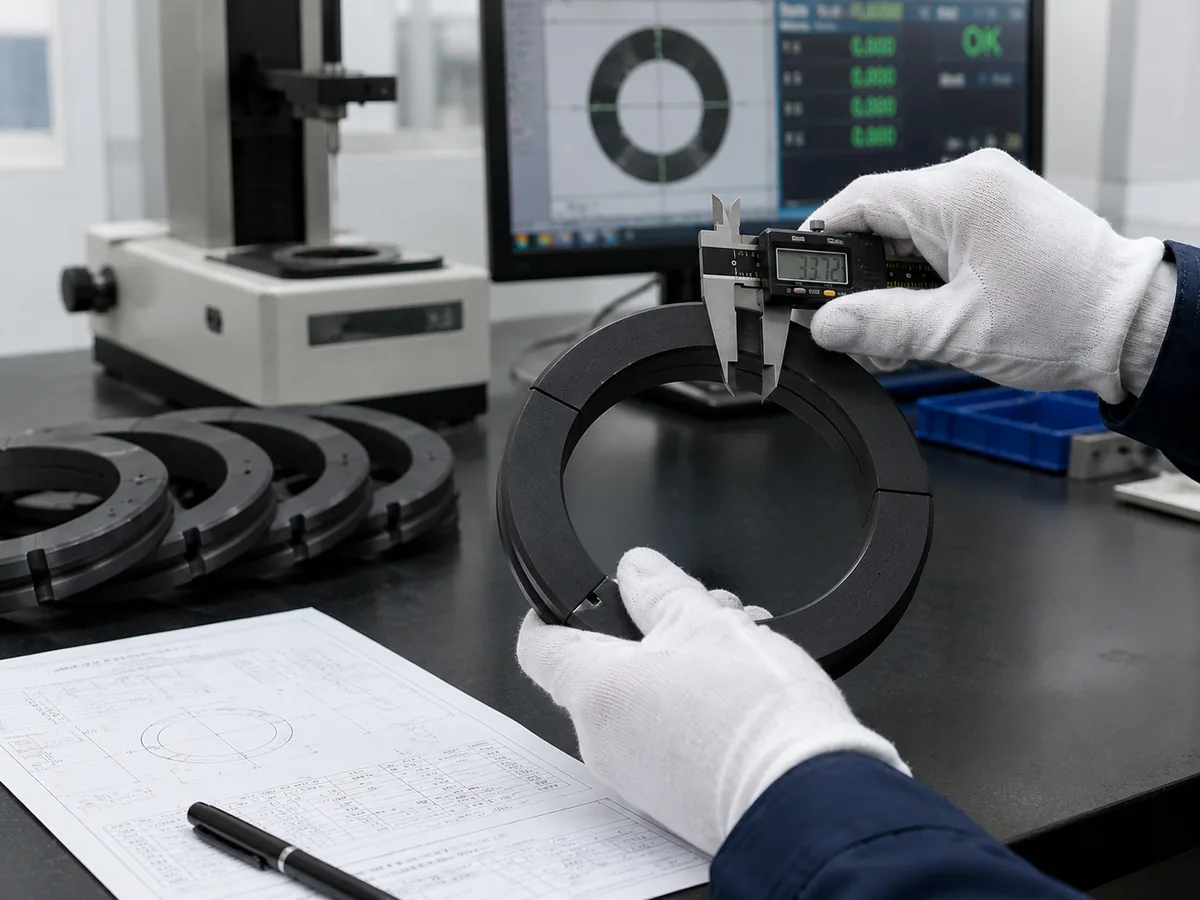
Finished Carbon Seal Manufacturing & QC
CARBOLVE precision machines finished carbon and graphite sealing components according to the approved specification. (Note: Finished-component machining is distinct from raw mechanical carbon material manufacturing).
Precision Machining
Turning, milling, segment cutting, joint machining, and groove/feature machining to drawing tolerances.
Seal-Face Finishing
Mechanical face products undergo surface finishing and lapping (where verified) to establish the specified working surface.
Type-Specific Quality Control
Dimensional inspection (OD, ID, thickness), segment matching, joint alignment, and visual inspection for edge integrity.
Technical Comparisons for Specification
Clarifying common engineering distinctions for custom carbon seals.
Standard vs. Custom Carbon Seals
Custom is not automatically better. An existing approved standard catalog size should be used when it already satisfies the application. Custom is required when material, geometry, or functional features must be project-specific based on a drawing or operating condition.
Custom vs. Replacement
A replacement project aims to reproduce an existing specification. A custom project modifies or creates a new controlled specification (e.g., new OEM, material change, or recovering an obsolete design without drawings).
Mechanical Seal Face vs. Segmented Ring
Mechanical seal faces provide axial/end-face sealing against an opposing face (key geometry: flatness, face width). Segmented rings provide circumferential/radial sealing around a shaft (key geometry: clearance, joints, segments).
Carbon vs. Silicon Carbide (SiC) Faces
Often complementary in a mechanical seal face pair. Carbon graphite provides softer, self-lubricating sliding behavior. SiC provides a hard counterface with high wear resistance. The decision is normally a face-pair decision, not choosing one independently.
What Does Your Existing Carbon Seal Tell Us?
Visual appearance alone does not establish root cause. We evaluate the complete system.
Leakage
Should be evaluated at the system level. May originate from flatness, mating face, secondary seals, shaft movement, or incorrect clearance rather than the carbon material automatically.
Rapid Wear
Possible contributors: abrasives, damaged mating surface, excessive contact, temperature limits, low lubrication, runout, or wrong material grade.
Cracking / Breakage
Possible contributors: mechanical impact, installation stress, thermal shock, binding, vibration, or improper support.
Blistering / Scoring
Possible contributors: fluid penetration, thermal condition, dry running, solids, or damaged mating face.
Frequently Asked Questions
Technical answers regarding custom carbon seal engineering and manufacturing.
Can CARBOLVE manufacture carbon seals from dimensions only?
Can CARBOLVE reproduce a worn carbon seal?
Can carbon seal material be identified by color?
Can one carbon grade replace another?
How flat should a carbon mechanical seal face be?
Is there a universal carbon ring clearance?
Are custom industrial carbon seals the same as turbocharger carbon seals?
What Information Is Needed for a Quote?
Not every item is required for every project. Send all information currently available, and CARBOLVE can identify additional data required during technical review.
1. Project & Seal Type
- OEM, Custom Geometry, Obsolete, etc.
- Mechanical Face, Segmented Ring, etc.
2. Existing Information
- Drawing, photos, or physical sample
- Equipment model & existing material
3. Operating Conditions
- Media, Temp, Pressure, RPM, Solids
- Mating face or shaft material