
Carbon Seal manufacturer
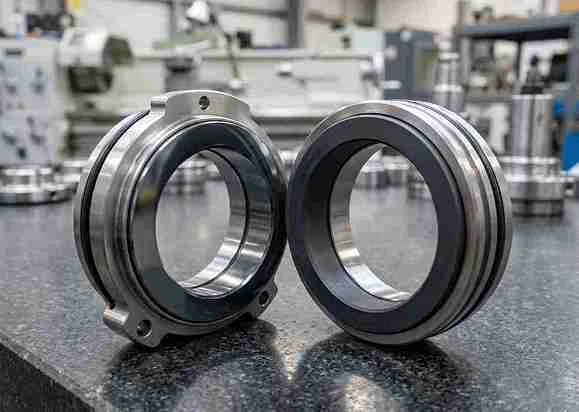
As a specialized manufacturer, we engineer high-performance carbon seals designed for superior leakage control and extreme durability. Utilizing premium self-lubricating graphite and advanced resin-impregnated materials, our seals provide exceptional thermal stability and chemical resistance in high-speed rotary applications.
From standard mechanical seals to custom-engineered industrial components, we ensure every product meets rigorous precision standards to minimize friction and extend your equipment’s service life.
- Home
- »
- Carbon Seal
Our Carbon Seal Products
We manufacture high-precision carbon seals using premium self-lubricating graphite. Engineered for superior thermal stability and chemical resistance, our products ensure leak-free performance and extended service life in demanding rotary applications.
Designed for large-diameter shafts and high-speed turbines, these segmented seals allow for thermal expansion and radial movement. Their precision-interlocking design ensures consistent contact and reliable sealing performance under fluctuating pressure and temperature conditions.
Our carbon bushings are the ideal solution for applications where conventional lubricants fail. Resistant to extreme heat and corrosive chemicals, these self-lubricating components provide stable support and sealing for submerged pumps and high-temperature conveyor systems.
Manufactured to ultra-fine tolerances, these specialized seals are used in high-tech analytical instruments and medical devices. They offer high chemical purity and low outgassing properties, ensuring zero contamination and precise pressure control in sensitive environments.
Beyond standard specifications, we provide full OEM/ODM services for unique sealing challenges. Our engineers work with diverse impregnations—such as resin, antimony, or babbitt—to develop bespoke seals tailored to your specific chemical, thermal, and mechanical requirements.
Our Capabilities
We are the carbon seal manufacturer in China for more than 20+years. We excel in high-precision manufacturing, utilizing advanced CNC technology to achieve micron-level tolerances. Our facility processes premium carbon-graphite grades, ensuring every seal delivers exceptional surface flatness and airtight integrity for demanding rotary systems.
Furthermore, we offer specialized material treatments, including resin and metal impregnations. This expertise allows us to enhance chemical resistance and thermal stability, providing durable, self-lubricating sealing solutions tailored to your specific industrial requirements.
OEM & ODM
Our team delivers full OEM/ODM support, from rapid prototyping to high-volume precision manufacturing. We ensure every custom component integrates seamlessly, maximizing equipment reliability and performance across specialized industrial applications.
- Tailored material grades for extreme industrial environments.
- Precision engineering ensures perfect fit and zero leakage.
- Rapid prototyping accelerates your product development cycles.
- Highly durable designs significantly reduce maintenance costs.
About our Factory
Where Master Craftsmanship Meets Absolute Purity—Engineering the Future of Sealing Excellence in a Pristine Environment.
Our carbon seal manufacturing facility is a testament to the synergy between high-tech engineering and rigorous environmental control. We maintain a sterile, temperature-regulated atmosphere to ensure that the physical properties of our specialized carbon graphite remain stable throughout the molding and machining processes.
By eliminating microscopic contaminants and managing thermal expansion at the source, we guarantee that every seal meets the ultra-tight tolerances required for high-speed aerospace and industrial applications.


Factory Environment
Carbolve is a model of efficiency and safety, contributing to the superior quality of our carbon products. contributing to the superior quality of our carbon products.
Frequently Asked Questions
Got questions about our products or services? Our FAQ section provides quick and clear answers to common queries. Dive in to learn more about HuiXiang Steel Co., Ltd. and how we can serve your steel needs.
Carbon graphite is uniquely suited for high-speed environments because of its self-lubricating properties and excellent thermal conductivity. Unlike metal-to-metal contact, carbon seals generate minimal friction, which prevents overheating. They can handle high peripheral speeds (up to $150$ m/s) and maintain structural integrity across a massive temperature range, from cryogenic levels to over $500$°C.
One of the greatest advantages of carbon seals is their ability to operate in dry or boundary lubrication conditions. The microscopic structure of the carbon allows a thin, lubricating film to form on the mating surface. This prevents catastrophic failure in applications where liquid lubrication is inconsistent or impossible, such as in aircraft engine main shafts or dry gas compressors.
The "service life" is generally influenced by three factors: Mating surface finish, pressure-velocity (PV) levels, and chemical environment. To maximize longevity, the mating ring should have a high degree of flatness and hardness. Additionally, while carbon is chemically inert to most substances, strong oxidizing agents at high temperatures can lead to premature wear, which is why we offer specific impregnated grades (e.g., antimony or resin-filled) for harsher tasks.
Absolutely. We utilize various impregnation techniques to tailor the seal's porosity. For instance, resin impregnation enhances leak-tightness for gases, while antimony or metal-filled carbon is used for high-pressure and heavy-duty mechanical loads. We work closely with clients to select the exact grade of carbon that matches their specific pH and pressure requirements.
Carbon seals are generally designed to be "low-maintenance," but they are sensitive to improper installation and contamination. During routine inspections, it is critical to check for "chipping" on the seal edges and to ensure the seal faces are free from grit or abrasive particles. Because carbon is brittle, we recommend specialized handling tools to ensure the seal remains pristine before it enters the housing.
Raw carbon graphite is inherently porous, which can lead to "wicking" or micro-leakage in high-pressure gas systems. To solve this, we utilize a process called Vacuum Pressure Impregnation (VPI). By filling the carbon’s internal voids with high-performance resins, metals (like antimony), or specialized salts, we create an impermeable barrier. This ensures the seal remains 100% leak-proof even under extreme pressure differentials, while simultaneously increasing the material's mechanical strength and wear resistance.
Yes, carbon seals are renowned for their exceptional thermal shock resistance. Unlike many ceramics or metals that may crack or warp when subjected to sudden temperature swings, carbon graphite has a low coefficient of thermal expansion and high thermal conductivity. This allows the seal to dissipate heat quickly and maintain its dimensional stability. Whether it’s an aerospace turbine igniting or a cryogenic pump starting up, our seals are engineered to handle $300$°C+ temperature spikes without compromising the sealing interface.
The Ultimate Guide to choose the Carbon Seal Manufacturer
Whether you are navigating extreme temperatures, high-pressure gas environments, or corrosive chemical processing, this guide is designed to help technical engineers and procurement specialists identify a partner capable of delivering precision-engineered carbon seals that meet the most rigorous global standards.
Table of Contents
Why is material grade selection the most critical factor when choosing a manufacturer?
Carbon seals are used in environments ranging from high-speed aerospace turbines to corrosive chemical pumps. A high-quality manufacturer must offer a wide spectrum of material grades, including antimony-impregnated, resin-bonded, and oxidization-resistant carbons. They should have the engineering depth to match the specific grade to your application’s pressure, temperature, and chemical compatibility, ensuring the seal doesn’t degrade or seize under stress.
Beyond just offering variety, the manufacturer must demonstrate a deep understanding of the “tribological” properties of their materials—specifically how the carbon interacts with the mating ring. If the manufacturer lacks the R&D to provide a customized material solution, you risk premature seal failure, which can lead to catastrophic fluid leaks or mechanical damage. Choosing a partner with material expertise is the first step in ensuring long-term system integrity.
How does a manufacturer’s precision machining capability affect seal performance?
Carbon is a brittle material that requires specialized machining techniques to achieve the extreme flatness and surface finish necessary for a “gas-tight” or “liquid-tight” seal. You should look for a manufacturer that utilizes advanced lapping and polishing technology to reach flatness tolerances measured in “light bands” (often less than 0.0006 mm). Any deviation in flatness can cause immediate leakage or uneven heat distribution, which quickly destroys the seal face.
Furthermore, the manufacturer must be able to hold tight tolerances on complex geometries, such as balanced seal designs or those with intricate grooves for hydrodynamic lifting. A manufacturer with in-house CNC capabilities and rigorous metrology departments can ensure that every seal ring fits perfectly within its housing. This level of precision is what differentiates a high-performance seal from a generic replacement that might fail upon startup.
What role does "Impregnation Technology" play in seal quality?
Raw carbon-graphite is naturally porous, which can allow gases or liquids to seep through the material itself. A top-tier manufacturer uses vacuum-pressure impregnation to fill these pores with specialized resins, metals (like antimony or copper), or salts. This process not only makes the seal impermeable but also significantly enhances its mechanical strength, thermal conductivity, and self-lubricating properties in “dry-running” scenarios.
The quality of the impregnation process is vital because poorly impregnated carbon can “bleed” or blister when exposed to high temperatures or volatile chemicals. When evaluating a manufacturer, ask about their impregnation depth and consistency. A reliable supplier ensures that the treatment is uniform throughout the entire part, so that as the seal wears down over time, the performance characteristics remain unchanged rather than degrading as the outer layer disappears.
How can I verify the manufacturer’s quality control for high-pressure applications?
High-pressure environments demand that carbon seals have exceptional “hoop strength” and resistance to deformation. You should prioritize manufacturers who perform non-destructive testing, such as ultrasonic inspections or pressure-leak testing, to ensure there are no internal cracks or structural flaws. Certifications like ISO 9001 are a baseline, but industry-specific standards like API 682 (for pumps in the oil and gas sector) are even better indicators of quality.
Additionally, consistency across batches is crucial. A reputable manufacturer should provide “Certificate of Conformance” (CoC) documents that include the specific physical properties—such as Shore hardness and density—of the exact batch your seals were cut from. This traceability ensures that if a seal performs well, you can replicate that performance with every subsequent order, avoiding the “maintenance lottery” associated with lower-end suppliers.
Why is "Thermal Conductivity" a key metric to discuss with your supplier?
During operation, friction between the seal face and the rotating shaft generates significant heat. If this heat isn’t dissipated quickly, it can lead to “thermal flashing” of the liquid being sealed or cause the carbon to crack due to thermal shock. A professional manufacturer will guide you toward materials with high thermal conductivity, such as metal-impregnated carbons, to help pull heat away from the seal interface and into the surrounding housing or fluid.
A manufacturer’s ability to model thermal gradients is also a major advantage. By simulating how the seal will expand and contract under operating temperatures, they can adjust the “clearance” or “interference fit” accordingly. This prevents the seal from becoming too loose (causing leaks) or too tight (causing excessive friction) as the machinery warms up, ensuring stable performance from cold start to peak operation.
Should I choose a manufacturer that offers "Mating Ring" compatibility testing?
A carbon seal never works alone; it is always part of a “seal couple” with a mating ring (usually made of silicon carbide, tungsten carbide, or stainless steel). A superior manufacturer won’t just sell you the carbon; they will analyze the entire interface to ensure the materials are compatible in terms of friction coefficients and wear rates. They should be able to recommend the ideal mating surface finish to promote the formation of a stable “transfer film.”
If the manufacturer doesn’t understand the interaction between the carbon and the counter-face, you may experience “scuffing” or “abrasive wear,” where one material destroys the other. Choosing a supplier that offers comprehensive testing of the seal pair ensures that the system reaches its maximum possible service life, reducing the frequency of teardowns and the overall cost of maintenance for your plant or product.
What are the benefits of choosing a manufacturer with in-house "Blanks" production?
Many smaller suppliers buy “blanks” (unmachined cylinders of carbon) from third parties and simply machine them to size. However, the most reliable manufacturers control the entire process from the raw powder mixing and “baking” (carbonization) to the final machining. This vertically integrated approach allows for much tighter control over the chemical purity and grain structure of the carbon, which are fundamental to the seal’s reliability.
When a manufacturer controls the “front end” of production, they can develop custom “recipes” for unique challenges, such as extremely low-friction seals for high-altitude aerospace applications. It also reduces supply chain risks; you aren’t at the mercy of a third-party material supplier’s lead times or quality fluctuations. If your application is mission-critical, always ask if the manufacturer produces their own base materials.
How does the manufacturer handle "Self-Lubrication" in dry-running conditions?
One of the primary reasons to choose carbon seals is their ability to run without external lubrication. A high-quality manufacturer designs their carbon to release a microscopic film of graphite onto the mating surface, which acts as a solid lubricant. You should ask potential suppliers how their material performs during “boundary lubrication” or “dry-start” conditions, where the fluid film hasn’t yet formed or has temporarily failed.
Poorly designed carbon seals may “dust” excessively or seize when dry. A manufacturer with expertise in dry-running seals will often use specialized additives or “film-formers” within the carbon matrix to ensure the seal survives these high-friction periods. This capability is essential for equipment that undergoes frequent starts and stops or handles gases where liquid lubrication is impossible.
What is the significance of "Blister Resistance" in carbon seal selection?
In certain applications, particularly those involving high-viscosity oils or rapid temperature changes, carbon seals can suffer from “blistering”—the formation of small craters on the seal face. This is often caused by fluids trapped in the pores of the carbon expanding rapidly. A premium manufacturer will offer “blister-resistant” grades, which usually feature a specific pore structure and high-modulus resin systems designed to prevent this destructive phenomenon.
If your manufacturer isn’t aware of blistering risks, you may find your seals failing prematurely for no apparent reason. By discussing your fluid’s viscosity and the system’s thermal cycles with the manufacturer, you can determine if a specialized blister-resistant grade is necessary. This proactive approach prevents the need for “trial and error” in the field, saving you from expensive downtime and repeated repairs.
How important is "Technical Support and Failure Analysis" from the manufacturer?
Even the best seal can fail if the operating conditions change or if installation is handled incorrectly. A top-tier manufacturer should offer “post-mortem” failure analysis services. If a seal fails, you should be able to send it back to them for an expert review of the wear patterns, which can reveal issues like shaft misalignment, over-pressurization, or chemical attack that weren’t obvious to the maintenance team.
This level of support transforms the manufacturer from a vendor into a strategic partner. Instead of just replacing a broken part, they help you solve the root cause of the problem. When selecting a manufacturer, check if they have a dedicated engineering team available for consultation and whether they provide detailed installation guides or onsite training to ensure their products are used to their full potential.
Request Quote Now !
Our proficient engineers and designers are ready to partner with you in developing the ultimate personalized shipping experience.
Find A Carbon Seals Manufacturer?
Partner with a leading manufacturer of high-performance carbon seals, providing precision-engineered solutions for the most demanding industrial applications.
Contact Us Now !
Before starting to use our services, please fill in the following form to let us know which type of stainless steel duct system you want to import from China.