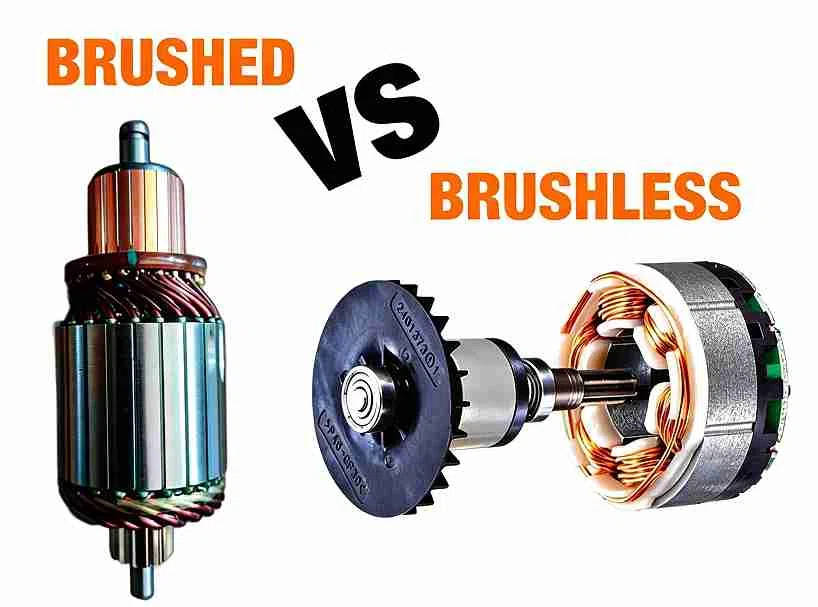
Brush motors use physical carbon brushes and a commutator to deliver power to the rotor, while brushless motors use electronic controllers to switch current through electromagnets. Brushless motors offer higher efficiency (85-90% vs 75-80%), longer lifespan, less maintenance, and better power-to-weight ratios, but cost significantly more than traditional brush motors.
What is a Brush Motor?
A brush motor (or brushed DC motor) is a traditional electric motor design that uses physical carbon brushes pressed against a rotating commutator to deliver electrical current to the motor’s armature. This mechanical switching system has been the standard motor technology for over a century, powering everything from household appliances to power tools and hobby RC vehicles.
Core Technology: The brush motor operates through direct mechanical contact. Carbon brushes maintain constant pressure against the commutator (a segmented copper ring), which rotates with the motor shaft. As the commutator spins, it alternates the current direction in the rotor windings, creating continuous rotation through electromagnetic interaction with permanent magnets in the stator.
Construction: The motor housing contains permanent magnets on the exterior (stator), while the rotating armature (rotor) sits in the center with wire windings. The brushes are spring-loaded components that gradually wear down through friction, requiring periodic replacement.
Common Applications: Brush motors remain popular in cost-sensitive applications including basic power drills, children’s toys, automotive starter motors, small appliances, and entry-level RC cars where initial cost outweighs long-term efficiency concerns.
What is a Brushless Motor?
A brushless motor eliminates physical brushes entirely by using electronic controllers (ESCs) to switch current through stationary electromagnets surrounding a rotating permanent magnet core. This inverted design—where the magnets rotate and the coils remain stationary—enables higher efficiency, reduced friction, and virtually maintenance-free operation, making brushless technology the preferred choice for modern high-performance applications.
Core Technology: The brushless design reverses the traditional motor configuration. Permanent magnets are mounted on the rotor (the rotating part), while electromagnetic coils are fixed to the stator (stationary housing). An electronic speed controller (ESC) precisely times the current pulses to each coil based on rotor position feedback from Hall effect sensors or back-EMF detection.
Construction: The motor features a multi-pole permanent magnet rotor surrounded by precisely wound stator coils. Without brushes creating friction and electrical arcing, the motor generates less heat and experiences minimal wear. The ESC acts as the “brain,” replacing mechanical commutation with digital switching at frequencies up to 20,000 times per second.
Common Applications: Brushless motors dominate in performance-critical environments including professional power tools, electric vehicles, drones, computer cooling fans, industrial automation, high-end RC vehicles, and precision robotics where efficiency and reliability justify the higher initial investment.
Key Differences: Brush Motor vs. Brushless Motor
Efficiency and Power Output: Brushless motors achieve 85-90% efficiency compared to 75-80% for brush motors. This 10-15% difference translates directly to longer battery runtime in cordless tools and vehicles. Brushless designs also deliver higher torque-to-weight ratios because they eliminate energy losses from brush friction and electrical resistance at the commutator interface.
Maintenance and Lifespan: Brush motors require periodic brush replacement (typically every 50-100 hours of operation) as carbon brushes wear down through constant friction. Brushless motors have no wearing contact points, often lasting 10,000+ hours without maintenance. The absence of brushes also eliminates carbon dust contamination in sensitive environments.
Cost and Complexity: Brush motors cost 30-50% less initially due to simpler construction and no electronic controller requirement. Brushless systems require sophisticated ESCs with microprocessors, adding $20-200+ to manufacturing costs depending on power rating. However, total cost of ownership often favors brushless due to reduced maintenance and energy consumption.
Speed Control and Performance: Electronic commutation in brushless motors enables precise speed control, instant torque response, and programmable performance profiles. Brush motors offer adequate performance for constant-speed applications but struggle with precise low-speed control and rapid acceleration/deceleration cycles.
| Feature | Brush Motor | Brushless Motor |
|---|---|---|
| Efficiency | 75-80% | 85-90% |
| Lifespan | 1,000-3,000 hours | 10,000+ hours |
| Maintenance | Brush replacement required | Maintenance-free |
| Initial Cost | $10-50 (typical) | $30-150+ (typical) |
| Weight | Heavier (same power) | 20-30% lighter |
| Noise Level | Higher (brush friction) | Quieter operation |
| Speed Control | Basic (voltage-based) | Precise (electronic) |
| Heat Generation | Higher | Lower |
ClearFilter Pro Tip: When choosing between brush and brushless for power tools, we recommend calculating total cost over 3 years. A $60 brushless drill that runs 40% longer per charge and never needs brush replacement typically outperforms a $40 brushed equivalent within 18 months of regular use. For occasional DIY users (under 20 hours/year), brush motors remain economically sensible.
Pros & Cons Comparison
| Aspect | Brush Motor | Brushless Motor |
|---|---|---|
| Initial Investment | ✅ Lower cost ($10-50) | ❌ Higher cost ($30-150+) |
| Energy Efficiency | ❌ 75-80% efficiency | ✅ 85-90% efficiency |
| Runtime (battery) | ❌ Shorter (baseline) | ✅ 30-50% longer |
| Maintenance Needs | ❌ Brush replacement every 50-100hrs | ✅ Zero maintenance |
| Lifespan | ❌ 1,000-3,000 hours | ✅ 10,000+ hours |
| Weight | ❌ Heavier (same power) | ✅ 20-30% lighter |
| Noise | ❌ Louder (brush friction) | ✅ Quieter operation |
| Speed Control | ❌ Basic voltage control | ✅ Precise electronic control |
| Complexity | ✅ Simple, repairable | ❌ Requires ESC, harder to repair |
| Durability | ❌ Brush wear, commutator degradation | ✅ No wearing contact points |
| Best For | ✅ Budget tools, low-use applications | ✅ Professional use, performance needs |
Conclusion
The brush motor vs brushless motor decision ultimately depends on your specific application requirements and budget constraints. Brush motors remain viable for cost-sensitive, low-duty-cycle applications where simplicity and repairability matter more than efficiency. Their straightforward design makes them ideal for disposable consumer products, educational projects, and occasional-use tools.
Brushless motors represent the superior technology for any application involving frequent use, battery power, or performance demands. The higher upfront cost is consistently offset by longer runtime, extended lifespan, and elimination of maintenance expenses. Professional tradespeople, serious hobbyists, and manufacturers prioritizing product quality should default to brushless technology.
We’ve observed the power tool industry transitioning almost entirely to brushless platforms over the past decade, with major manufacturers phasing out brushed models in their premium lines. This market shift reflects the compelling total-cost-of-ownership advantages that brushless technology delivers despite initial price premiums.
FAQ
1. Can I replace a brush motor with a brushless motor in my existing tool?
Direct replacement is rarely possible without significant modifications. Brushless motors require compatible electronic speed controllers (ESCs) and often have different mounting dimensions and electrical connections. Some manufacturers offer conversion kits for specific models, but purchasing a new brushless tool is typically more cost-effective than retrofitting.
2. How long do brushes last in a brush motor?
Brush lifespan varies from 50-100 hours in high-performance applications to 500+ hours in light-duty motors. Factors affecting wear include operating temperature, load intensity, duty cycle, and environmental contamination. You’ll notice decreased performance, excessive sparking, or unusual noise when brushes need replacement.
3. Are brushless motors more powerful than brush motors?
Brushless motors aren’t inherently more powerful, but they deliver power more efficiently. A 500-watt brushless motor typically outperforms a 500-watt brush motor by 10-15% because it converts more electrical energy into mechanical work rather than heat and friction losses. This efficiency advantage translates to higher effective torque and speed.
4. Why are brushless motors more expensive?
The cost premium comes from the electronic speed controller (ESC), which contains microprocessors, power transistors, and sophisticated circuitry to manage commutation. Brushless motors also require tighter manufacturing tolerances and precision-wound stator coils. ESCs alone add $20-200+ depending on power rating and features.
5. Do brushless motors work with standard batteries?
Yes, brushless motors operate on the same DC voltages as brush motors (commonly 12V, 18V, 20V for power tools). However, they draw current more efficiently, extending battery runtime by 30-50% compared to equivalent brush motors. The ESC handles voltage regulation and current management automatically.
6. Which motor type is better for RC cars and drones?
Brushless motors dominate modern RC applications due to superior power-to-weight ratios, precise speed control, and durability. Entry-level RC vehicles still use brush motors for cost savings, but serious hobbyists universally prefer brushless for competitive performance, programmability, and reduced maintenance during intensive use.
7. Can brushless motors overheat?
While brushless motors generate less heat than brush motors at equivalent power levels, they can still overheat under sustained high-load conditions or inadequate cooling. Quality ESCs include thermal protection that reduces power or shuts down the motor when safe temperature thresholds are exceeded, preventing permanent damage.
8. Are brush motors being phased out completely?
Not entirely, but their market share continues declining. Brush motors remain cost-effective for disposable products, very low-power applications (under 50 watts), and situations where electronic controllers would be impractical. However, in rechargeable power tools, automotive applications, and performance equipment, brushless technology has become the industry standard.